
KABUL, AFGHANISTAN – The Organization of Islamic Cooperation (OIC) has said the crisis in Afghanistan will be among the key issues discussed at its 52nd Council of Foreign Ministers meeting in Baghdad, Iraq, as the organization’s special envoy has urged Taliban officials to uphold girls’ right to education, including access to medical studies.
The two-day meeting is scheduled for October 17 and 18. In a post on X on Wednesday, the OIC said the agenda would include major regional issues, including the situation in Yemen, the crises in Sudan and Afghanistan, Israel’s aggression against Syria, and the situation of Muslim minorities and communities. The meeting will also review the organization’s 2025 Islamophobia report.
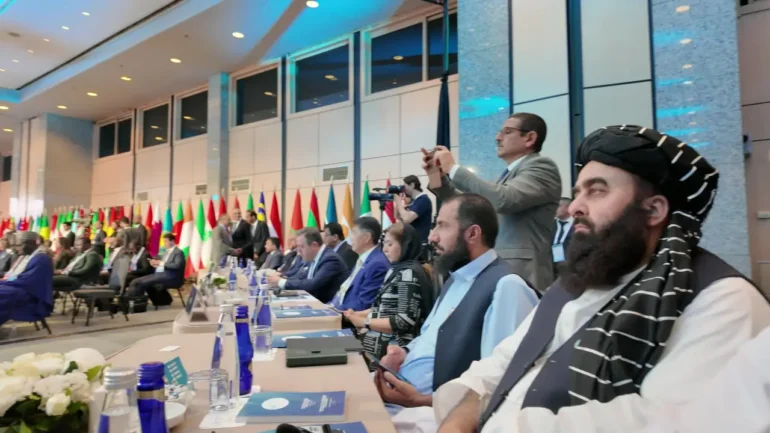
The announcement comes after an OIC delegation visited Kabul in recent days and held meetings with Taliban officials, United Nations representatives and the European Union to discuss Afghanistan’s humanitarian situation, education and development needs.
During a meeting with Noor Jalal Jalali, the Taliban’s acting minister of public health, Tariq Ali Bakheet, the OIC secretary-general’s special envoy for Afghanistan, stressed the importance of girls’ right to education and the need to enable them to pursue medical studies.
According to an OIC statement, Bakheet said the participation of female health workers was vital to the delivery of healthcare services.
The Taliban have banned girls from attending secondary school and women from university education since returning to power in August 2021. The restrictions have raised concerns about a growing shortage of female healthcare professionals, which threatens women’s access to medical care in a country where cultural restrictions and the requirement for women to be treated by female practitioners can further limit access to services.
Despite repeated international criticism, the Taliban have refused to reverse the restrictions.
Bakheet also met with Habibullah Agha, the Taliban’s acting minister of education, to discuss the education curriculum, girls’ right to education and several proposed OIC projects aimed at developing Afghanistan’s education sector.
Afghanistan remains the only country in the world where authorities systematically prohibit girls from pursuing secondary and higher education. The Taliban have also imposed extensive restrictions on women’s employment and participation in public life.
The OIC and several other Islamic institutions have repeatedly criticised these restrictions and called for them to be lifted. At a previous OIC meeting in Islamabad, participants expressed deep concern over the suspension of girls’ education and women’s employment opportunities in Afghanistan, warning that the restrictions damage the image of Islam.
During the recent Kabul visit, the OIC delegation also discussed humanitarian needs and ongoing international efforts with Scott Smith, head of the political affairs section of the UN Assistance Mission in Afghanistan (UNAMA), and Tajuddin Oyewale, a UNICEF representative. The discussions focused on humanitarian conditions and the importance of continued dialogue and coordination among international partners to address Afghanistan’s needs.
The OIC envoy also met European Union representatives to discuss humanitarian assistance and potential cooperation in key areas, including healthcare, education and alternative livelihoods for poppy farmers.
The engagement comes as Afghanistan faces a prolonged humanitarian crisis, with millions of people requiring assistance and restrictions on women’s participation in education and employment undermining the country’s ability to meet its development and healthcare needs.
Founded in 1969, the Organization of Islamic Cooperation is the world’s second-largest intergovernmental organization after the United Nations, with 57 member states across four continents. It seeks to strengthen cooperation among Muslim-majority countries and protect their shared interests through diplomacy, humanitarian assistance and development initiatives.
In Afghanistan, the OIC has maintained engagement through its special envoy and Kabul mission, focusing on humanitarian assistance, healthcare, education and economic livelihoods. Its humanitarian department coordinates relief efforts with member states and international partners, including the United Nations and the European Union.
The Baghdad meeting is expected to provide a further opportunity for member states to discuss Afghanistan’s humanitarian and political challenges. However, whether the discussions will lead to concrete measures to improve girls’ access to education and women’s employment remains to be seen.