

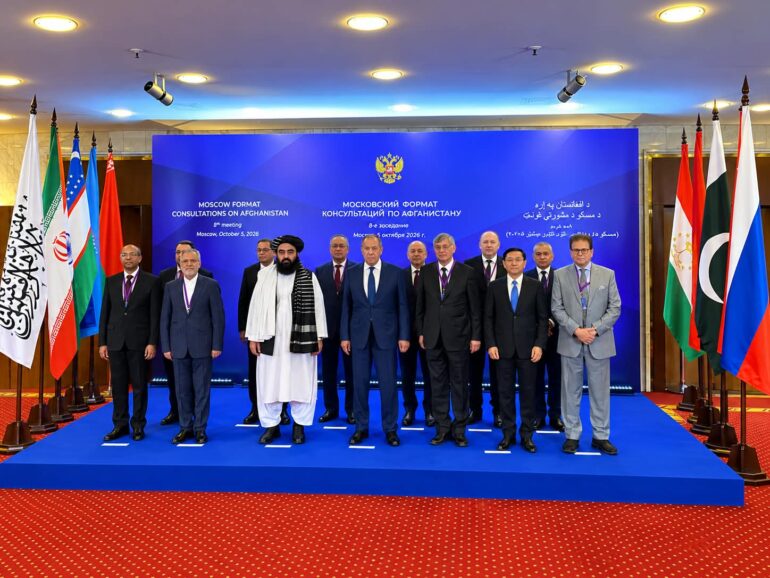

KABUL, AFGHANISTAN – The eighth round of Moscow Format consultations on Afghanistan ended without a joint statement on Monday because of disagreement between the Taliban and Pakistani delegations over the text, Russia’s special representative for Afghanistan said.
Speaking at a news conference following the meeting, Zamir Kabulov said the participants encountered differences between the Afghan and Pakistani delegations while preparing the final text.
“When drafting the final joint statement, we encountered one problem – that problem was that our Afghan and Pakistani colleagues didn’t see eye to eye. We regret this,”Kabulov said, according to Russia’s TASS news agency.
Kabulov said the Taliban delegation objected to wording that mentioned Afghanistan too often in a terrorist context. The Taliban argued that similar wording had been used in last year’s statement but that bilateral relations had changed since then.
“The Moscow Format can work and continue to exist without this joint statement,” Kabulov said. “But it would be more in line with tradition, more proper. The Moscow Format remains as a platform, but it is not a platform for resolving bilateral disagreements; it is a platform for coordinating regional cooperation.”
The Moscow Format was established in 2017 as a regional consultative mechanism focused on political, security and economic developments in Afghanistan. It brings together special representatives and senior officials from Afghanistan, India, Iran, Kazakhstan, China, Kyrgyzstan, Pakistan, Russia, Tajikistan and Uzbekistan.
The latest meeting opened in the Russian capital earlier on Monday. Russian Foreign Minister Sergei Lavrov, Taliban Foreign Minister Amir Khan Muttaqi and representatives from India, Iran, Kazakhstan, China, Pakistan, Tajikistan and Uzbekistan took part. Delegations from Belarus and Egypt attended as guests.
Taliban, Pakistan trade accusations
In his speech, Amid Khan Muttaqi accused the Pakistani military of launching a new project aimed at challenging stability in Afghanistan and the wider region.
He claimed Pakistan has gathered thousands of former Afghan military personnel and Islamic State members near the border. Muttaqi said the Taliban believes the political, security and economic problems between the two sides could be resolved through dialogue and diplomacy, not military action.
Pakistan’s special envoy for Afghanistan, Mohammad Sadiq, countered that terrorism remains the core of Afghanistan’s problem. He said groups including Tehrik-e-Taliban Pakistan, the Balochistan Liberation Army, the East Turkestan Islamic Movement, Islamic State Khorasan Province and al-Qaeda continue to operate from Afghan territory with impunity, posing the most serious security threat to Pakistan.
“Over the last three years alone, more than 4,700 innocent Pakistanis have lost their lives to terrorism emanating from Afghanistan,” Sadiq said, adding that no country would tolerate such a situation. He described Pakistan’s military operations as “precise, intelligence-based and defensive in nature.”
Sadiq said Pakistan would continue to take all appropriate measures to uphold the safety and security of its citizens in accordance with international law, based on the principles of necessity and as a measure of last resort. He characterized the actions as legitimate defensive steps against sanctuaries and bases used for planning, training and launching attacks inside Pakistan.
Tensions between the Taliban authorities and Pakistan, once close allies, have continued for nearly a year. In the latest incident, Pakistan carried out airstrikes in two Afghan provinces last week. The United Nations said the strikes killed at least 10 civilians and injured nine others. The UN has also documented more than 1,100 civilian deaths and injuries from cross-border armed violence in Afghanistan so far in 2026. Islamabad said the attacks targeted hideouts of militant groups and killed dozens of fighters. Pakistan accuses the Taliban of allowing Tehrik-e-Taliban Pakistan and other militants to use Afghan soil to plan and launch attacks. The Taliban deny the allegation.
Participants in the Moscow Format called on both the Taliban and Pakistan to refrain from military actions and expressed readiness to help find a solution to the conflict. “The Moscow Format wasn’t established to settle conflicts between individual countries of this group. All parties without exception called on both sides to refrain from military action against one another, which primarily harms the civilian population, and expressed their readiness to assist and facilitate the search for political and diplomatic solutions,” Kabulov told TASS.
Kabulov also said that Russia is ready to help end the ongoing tension. “Russia is ready to assist in ending this conflict in any possible, permissible way — either on its own or in partnership with our other partners — provided that both sides make such a request. We are ready to provide the maximum possible assistance,” he said.

