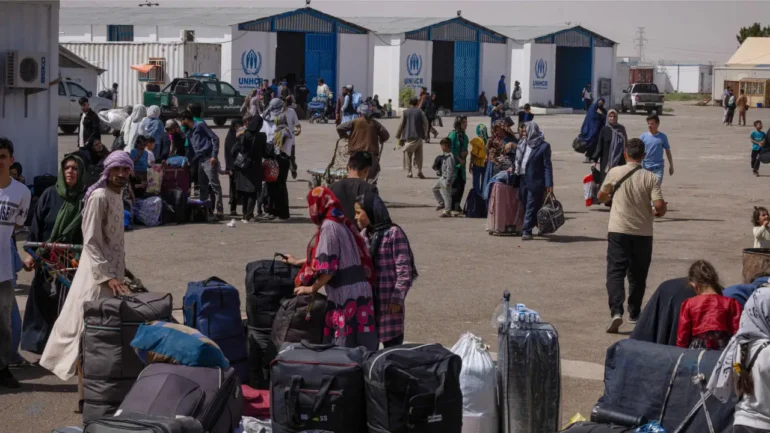

KABUL, AFGHANISTAN – More than half of Afghan returnees are unable to meet their basic needs, while many lack adequate housing, stable employment and identity documents, according to the International Organization for Migration (IOM), as the United Nations warns that thousands of returning families need urgent shelter and winter assistance.
In its October 2026 Returnee Resilience Overview – Afghanistan, Round 3, IOM said 54 percent of the returnees surveyed were unable to meet their basic needs. The report examines the reintegration of Afghan returnees, including their livelihoods, housing, civil documentation, access to essential services, safety and security, social cohesion, and plans for the future.
Mihyung Park, IOM’s chief of mission in Afghanistan, said many returnees intended to remain in the country and rebuild their lives. However, their ability to do so depended on access to livelihood opportunities, safe shelter, identity documents and essential services, alongside support for host communities.
The report found that returnees continued to face overlapping barriers to reintegration. Among those surveyed, 53 percent had not completed any formal education, 50 percent had no specialized work experience, and 69 percent had been unemployed during the 30 days before their interviews.
Even among those who had found work, 71 percent were employed only part-time or in irregular or incomplete employment, limiting their ability to support themselves and their families.
Housing remained another major concern. According to the report, 77 percent of the returnees surveyed were living in temporary shelters, while 51 percent lacked adequate living space. Many depended on verbal rental agreements or accommodation provided by other people. Fourteen percent had been evicted since returning, most commonly because they could not afford rent.
IOM also highlighted the continuing need for identity documents and food assistance, warning that gaps in civil documentation undermined returnees’ access to essential services and their prospects for long-term stability.
The findings further showed that some returnees were reconsidering their decision to remain in Afghanistan. Among individual returnees, the proportion intending to leave the country stood at 11 percent in the first survey round, fell to five percent in the second, and rose to 16 percent in the third. Among returnee families, the corresponding figures were two percent, one percent and four percent.
In the third round, individual returnees were four times more likely than returnee families to plan to leave Afghanistan again. IOM said the findings highlighted the relationship between income, employment and decisions about future migration.
The organization said the three rounds of research showed that the pressures facing returnees remained significant and continued to change. It called for sustained investment in long-term solutions and area-based reintegration programmes that strengthen livelihoods, improve access to housing and identity documents, and expand essential services for returnees and their host communities.
The findings come as Afghanistan continues to receive large numbers of people returning from neighbouring Iran and Pakistan, including those forcibly deported under increasingly restrictive migration policies.
According to United Nations figures, approximately 6.5 million Afghans returned from Iran and Pakistan between September 2023 and August 31, 2026. The large-scale returns have placed additional pressure on an already fragile economy and overstretched public services, deepening humanitarian needs in a country where millions of people already struggle to access food, housing and healthcare.
As winter approaches, the UN Office for the Coordination of Humanitarian Affairs (OCHA) has warned that thousands of returning families urgently need shelter, heating, protection and other essential assistance.
In a message posted on X on Monday, October 12, OCHA said thousands of families returning to Afghanistan needed adequate shelter, warmth, protection and essential assistance as temperatures began to fall. The agency stressed that neither winter nor humanitarian assistance could wait.
Data from the UN Refugee Agency (UNHCR) showed that 1,298,370 Afghans returned from Iran, Pakistan and other countries during the first nine months of 2026. Of these, 715,400 returned from Pakistan and 581,600 from Iran. More than 563,000 of the total returnees had been forcibly deported, according to the figures cited in the report.
The United Nations has estimated that $529.2 million is needed to support approximately 2.7 million Afghan returnees in 2026. The response plan includes emergency assistance at border crossings, reintegration support, healthcare, education, shelter and livelihood opportunities.
The UN has also requested $1.71 billion for its broader humanitarian response in Afghanistan this year. However, only 31 percent of that amount, approximately $530 million, had been funded at the time of the figures cited, leaving a shortfall of around $1.18 billion.
The funding gap threatens to further constrain assistance for returnees and other vulnerable communities as winter approaches. The UN has warned that sustained support is needed not only when people cross the border but also during the difficult months that follow, when families must find housing, secure livelihoods and rebuild their lives in Afghanistan.