

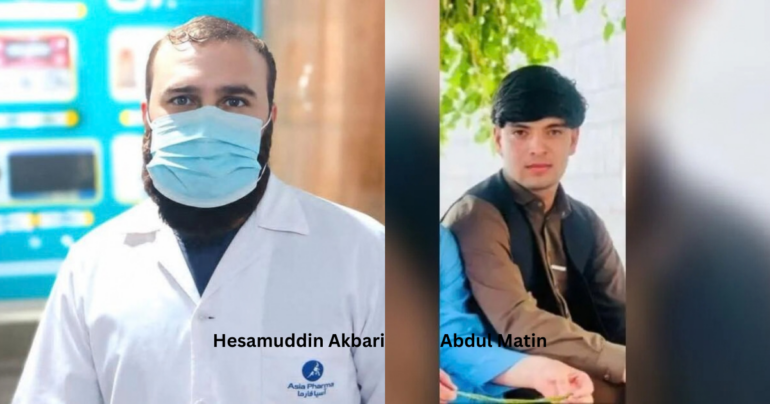

KABUL, AFGHANISTAN – A young man was found hanging in Farah province, while a dentist was shot dead in neighboring Badghis province, according to local sources.
Sources in Farah said the body of the young man was found on Saturday, September 19, in the Dasht-e Sufi area of Farah city, the provincial capital.
According to the sources, the young man was identified as Abdul Matin, a resident of the sixth district of Farah city.
The circumstances and cause of his death remain unclear. Local Taliban authorities have not commented on the incident.
A similar incident was reported five days earlier in Qalat city, the capital of Zabul province.
In a separate incident in Badghis, local sources confirmed that a dentist was shot dead in the provincial capital, Qala-e-Naw.
A source told KabulNow that the dentist, identified as Hesamuddin Akbari, was originally from Qadis district of Badghis.
According to the source, Akbari was shot dead on Friday night at a house in the Jar-e Bozkashi area of the first district of Qala-e-Naw.
Another source said Akbari operated a private dental clinic in Badghis and also worked at the provincial hospital.
The motive for the killing remains unclear.
Another source said Akbari’s family told them that he had left his home on Friday night after receiving a telephone call from one of his patients.
Local Taliban authorities in Badghis have not commented on the killing. The Taliban police spokesperson in the province did not respond to a message from an Etilaat Roz reporter seeking comment.
The two incidents come amid continued reports of unexplained deaths, killings and suspected suicides across Afghanistan. Since the Taliban returned to power in August 2021, local media and residents have repeatedly reported cases of mysterious deaths and suicides in different parts of the country, although the circumstances and causes of many such incidents remain unclear.
UNAMA has repeatedly documented serious concerns over killings and other security-related human rights violations in Afghanistan since the Taliban returned to power in August 2021. In a 2023 report covering the period from August 2021 to June 2023, UNAMA documented at least 800 cases involving extrajudicial killings, arbitrary arrests and detention, torture, ill-treatment and enforced disappearances of former government officials and security-force members.
More recent UN reporting continues to monitor killings and other human rights violations, while noting that insecurity and limited access to justice remain major concerns in the country.
A March 2026 report by the Afghan rights group Rawadari documented at least 611 cases of targeted, mysterious or extrajudicial killings and injuries across the country in 2025. That figure represented an increase of more than 40 percent from the previous year. Victims included former government employees, individuals accused of links to opposition groups, protesters, tribal elders and other community figures.
While the Taliban say they have restored security nationwide since returning to power in 2021, residents, civil society activists and rights groups continue to express concern over the protection of civilians, the absence of independent investigations and the lack of accountability for those responsible.

