

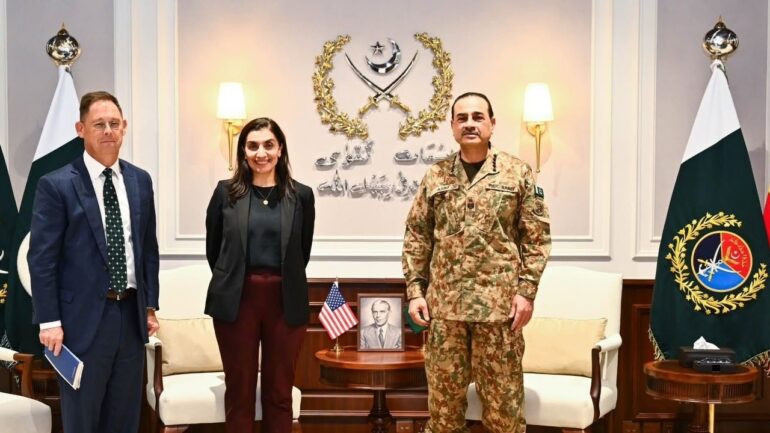

KABUL, AFGHANISTAN – A U.S. Afghanistan War Commission delegation met Pakistan’s army chief, Field Marshal Syed Asim Munir, on Monday as part of its comprehensive review of the United States’ 20-year war in Afghanistan, Pakistan’s military said.
The delegation, led by commission co-chairs Shamila N. Chaudhary and Colin F. Jackson, held talks with Munir at the General Headquarters in Rawalpindi, the Inter-Services Public Relations (ISPR) said in a statement.
The discussions covered matters of mutual interest, including Pakistan’s support during the conflict, the regional security environment and developments in Afghanistan, with a focus on perspectives relevant to the commission’s work, ISPR said.
Munir outlined Pakistan’s perspective on the security dynamics that shaped the long conflict. He highlighted the challenges Pakistan faced during the prolonged war in Afghanistan and stressed the importance of incorporating regional viewpoints and the country’s experience when assessing the strategic, diplomatic and operational dimensions of the war, according to the statement.
The U.S. delegation acknowledged Pakistan’s longstanding role and sacrifices during the war and appreciated its continued contribution to regional peace and stability, the military said.
The Afghanistan War Commission was established by the U.S. Congress in December 2021 as an independent, bipartisan body tasked with conducting a full review of the U.S. war in Afghanistan. Its mandate covers the period from September 2001, when the United States launched military operations following the Sept. 11 attacks, through the withdrawal of American forces in August 2021.
The commission is examining military operations, diplomacy, intelligence assessments, counterterrorism efforts, reconstruction and development assistance, political initiatives and senior-level U.S. government policy decisions. It is also reviewing the strategic and operational decisions that contributed to the course and outcome of the war, with the goal of drawing lessons for future U.S. military and foreign policy decisions.
US Congress last month extended the commission’s mandate by one year, giving the panel additional time to complete its work. Its final report is now due in August 2027.
The U.S.-led intervention began in October 2001 after the Sept. 11 attacks. The Taliban government was removed from power, and a new Afghan government was established with extensive international military and financial support. After two decades of fighting, the United States and its NATO allies withdrew their forces in August 2021. The Afghan government and security forces collapsed rapidly, and the Taliban returned to power.
The withdrawal and the collapse of the U.S.-backed Afghan government have been the subject of extensive scrutiny in the United States, including over the planning of the pullout, the evacuation of civilians and the decisions made during the two decades of military and political engagement.

