

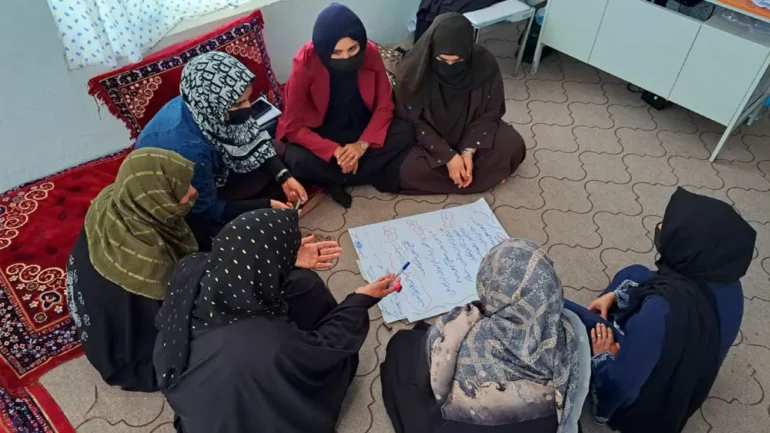

KABUL, AFGHANISTAN – A new United Nations Women report says women-led organizations and women’s rights organizations in Afghanistan are facing severe funding shortages following reductions in international aid, forcing many to scale back services, dismiss staff and, in some cases, consider suspending or ending their operations.
The report, titled “Afghanistan Beyond Breaking Point: The Impact of Aid Cuts on Women-Led and Women’s Rights Organizations,” is based on a survey of 74 women-led and women’s rights organizations conducted in April 2026. According to the report, 61 organizations, or 82 percent of those surveyed, said they were at risk of closure.
The organizations surveyed were asked about the effects of funding reductions on their operations since January 2025. UN Women said 72 percent of the organizations experienced funding cuts during 2025, while 49 organizations, or 66 percent of respondents, said their financial situation in 2026 had become “worse” or “critical” compared with the previous year.
One organization had already permanently closed, while 40 organizations, equivalent to 54 percent of respondents, said they believed they could be forced to suspend operations or shut down completely within the following 12 months.
The funding crisis has also affected the organizations’ ability to provide services to women and girls. Seventy-seven percent of respondents said their capacity to respond to the needs of women and girls was below the level required, while 83 percent said those needs had increased compared with previous years.
According to the survey, 62 percent of organizations are now reaching fewer women and girls than they did before January 2025. Another 54 percent said that because of limited capacity, they had been forced either to place women and girls on waiting lists or turn them away.
Services related to violence against women have been particularly affected. Seventy-six percent of the organizations reported a significant reduction or suspension of case-management and referral services for survivors of violence. Services providing safe spaces for women and girls had been reduced or become unavailable at 70 percent of the organizations, while 68 percent reported reductions or disruptions in livelihoods and economic-empowerment services.
The funding shortages have also resulted in significant job losses. Ninety-two percent of the 74 organizations surveyed said they had lost some of their employees. At 18 organizations, 60 percent or more of the workforce had been lost, while nine organizations said they had lost more than 90 percent of their staff.
Overall, 41 organizations, or 55 percent of respondents, identified staff reductions or suspensions as one of the consequences of declining funding. Sixty-five percent said they had relied on unpaid workers or volunteers to continue operating, while 54 percent said they had reduced staff salaries below the amounts specified in employment contracts.
The findings come as Afghan women’s civil society is already operating under severe restrictions. Since the Taliban returned to power in August 2021, women and girls have faced sweeping restrictions on education, employment, freedom of movement and participation in public life. UN Women has previously reported that women-led and women-focused organizations have been particularly affected by restrictions on women’s employment and by limitations imposed on their ability to operate.
In December 2022, Taliban authorities also banned Afghan women from working for national and international non-governmental organizations, a measure that humanitarian organizations warned could undermine their ability to reach women and girls who cannot safely access services provided by men. International organizations have repeatedly said that the participation of Afghan women workers is essential for delivering assistance to female beneficiaries.
The funding crisis has added another layer of pressure to an already restricted operating environment. UN Women said in an earlier gender alert that women-led organizations had been on the front lines of delivering essential services, documenting abuses and maintaining networks of support, but that funding reductions were forcing many of them to scale back or close. In a March 2025 survey of 207 organizations, nearly 40 percent said donor-dependent projects had been put on hold, while 25 percent reported having to dismiss women staff because of the funding freeze.
The reduction in international assistance has also occurred against the backdrop of broader cuts to global humanitarian funding. After President Donald Trump returned to the White House in January 2025, his administration ordered a pause and review of U.S. foreign assistance, followed by a major restructuring and dismantling of USAID. The changes disrupted humanitarian and development programmes worldwide.
The United States had previously been one of the largest providers of humanitarian assistance to Afghanistan. Before the 2025 changes, Washington said it had shifted its post-2021 assistance away from reconstruction and toward humanitarian aid and targeted programmes intended to meet basic needs and prevent further economic collapse.
The consequences of declining aid are particularly significant in Afghanistan, where humanitarian needs remain extensive. UN Women says restrictions on women’s rights have simultaneously reduced women’s access to education, employment, justice and public life while increasing their vulnerability and need for protection and support.
UN Women said the women-led and women’s rights organizations surveyed are calling for flexible, multi-year funding that can cover core operational costs rather than only individual projects. Given the restrictions on their work, most organizations also called for funding to be provided directly to women’s organizations and for donors to maintain direct communication with them.
The report warns that without more predictable and flexible funding, the closure of women-led organizations could further reduce the already limited spaces available to Afghan women to access services, document rights violations, organize collectively and participate in decisions affecting their lives.

