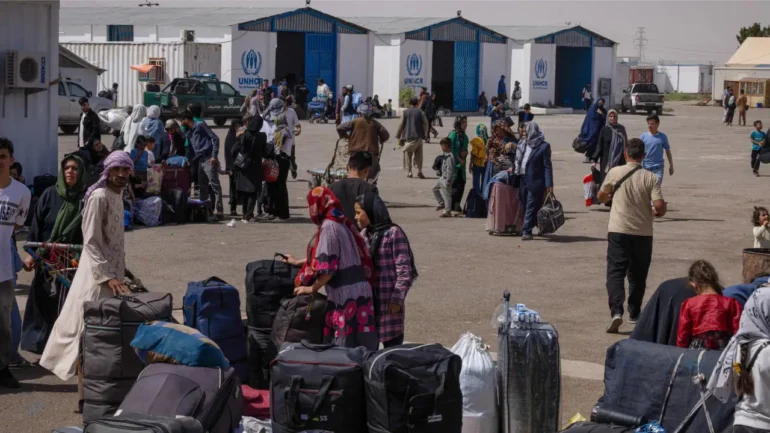

KABUL, AFGHANISTAN – The International Organization for Migration (IOM) says there is a significant disparity in the distribution of multipurpose cash assistance among Afghans returning from Iran and Pakistan, with returnees from Pakistan nearly three times more likely to have received cash assistance than those returning from Iran.
In its latest Afghanistan Returnee Resilience Report, published on Monday, September 28, IOM examined the situation of Afghan returnees between July and December 2025, including their access to humanitarian assistance, housing, food, livelihoods and their plans for the future.
The report is based on interviews with 1,547 returnees, including 888 people who returned from Pakistan and 659 who returned from Iran. IOM assessed their situation approximately nine to 15 months after their return to Afghanistan.
According to the report, 1.93 million Afghans returned from Iran and Pakistan during the second half of 2025. Of those, 38 percent received cash assistance after returning.
However, the proportion differed sharply between the two countries. Only 24 percent of returnees from Iran received multipurpose cash assistance, compared with 69 percent of those returning from Pakistan.
IOM did not specify the amount of cash distributed under the programme in its latest report. However, under its 2024 integrated returnee assistance programme, the agency had allocated $140 per returning family as multipurpose cash assistance, in addition to an average of $20 per individual for transportation costs. The cash assistance was intended to help families meet food and other essential needs.
IOM said returnees face a combination of immediate and longer-term needs after arriving in Afghanistan, with food emerging as the most widespread concern.
About 69 percent of returnees reported difficulties in meeting their food needs, while 67 percent needed assistance to obtain safe shelter. Seventy-seven percent were living in temporary accommodation, and 51 percent said they did not have enough space for their family members.
Livelihoods and employment were also major concerns. IOM said 56 percent of returnees identified employment and livelihood opportunities as a key need. Only five percent had productive assets or property that could generate income, while 54 percent said their income during the 30 days before the interview had been insufficient to cover their basic needs.
Despite these difficulties, most returnees did not intend to leave their current place of residence in the near future.
IOM found that 75 percent of respondents did not plan to leave their current location during the following six months. Six percent said they intended to leave Afghanistan, while five percent planned to move to another location inside the country. One percent intended to return to their original place of residence, while 13 percent were uncertain about their future plans.
There was a difference between families and individuals. Seventy-six percent of returnee families said they did not intend to move, compared with 69 percent of individual returnees. Meanwhile, 16 percent of individual returnees said they planned to leave Afghanistan again, compared with four percent of returnee families.
Women and children make up a substantial proportion of those returning. Of the returnees covered by the report, 48 percent were women and 52 percent were men, while 58 percent were children under the age of 18.
More than 6.4 million Afghans have returned since September 2023.
According to IOM, 6,473,978 Afghans returned from Iran and Pakistan between September 15, 2023, and August 31, 2026.
During the period covered by the latest report — July 1 to December 31, 2025 — 1,931,418 Afghans returned from the two neighbouring countries. Of these, 1,138,374 came from Iran and 793,044 from Pakistan.
The large-scale return movement has placed additional pressure on Afghanistan’s already limited housing, employment and public-service systems. IOM has warned that many returnees have spent years or even their entire lives outside Afghanistan and may arrive with limited social networks, unfamiliarity with local systems and restricted access to housing, livelihoods, documentation and basic services.
The recent increase in returns is linked to increasingly restrictive migration policies in both neighbouring countries, although the circumstances differ.
In Pakistan, the major turning point came in October 2023, when the government announced the Illegal Foreigners’ Repatriation Plan (IFRP), initially targeting undocumented foreigners, the majority of whom were Afghans. The policy was accompanied by arrests, detention and pressure on Afghans to leave. UNHCR said hundreds of thousands returned after the announcement, many under pressure or fearing arrest.
Pakistan subsequently expanded enforcement. In March 2025, the government announced that Afghan Citizenship Card holders would also have to leave, with deportations beginning in April. In July 2025, the policy was extended to Afghan refugees holding Proof of Registration cards after a short grace period. UNHCR reported that more than 614,600 Afghans had returned from Pakistan between April and September 2025 alone.
The pressure continued into 2026. IOM monitoring in Pakistan has repeatedly identified fear of arrest as the most frequently reported reason for return, with 95–99 percent of surveyed respondents citing it during several reporting periods.
In Iran, deportations have also been driven largely by stricter enforcement against undocumented Afghans and tighter residency controls. IOM says Iranian measures aimed at deporting large numbers of undocumented Afghan migrants significantly accelerated returns. Its monitoring has identified documentation problems, the risk of deportation and police harassment among the main difficulties faced by Afghans in Iran.
The pressure increased further in 2025 and 2026 amid broader political, economic and security developments in Iran. UNHCR monitoring has found that Afghans cited fear of arrest or deportation, economic conditions and conflict-related fears among the reasons for leaving Iran.
The scale of the movement increased dramatically in 2025. UNHCR estimated that about 2.9 million Afghans returned during that year, with policy changes, tighter documentation requirements, deteriorating socioeconomic and protection conditions, and enforcement measures in Iran and Pakistan among the main drivers.
The return of millions of Afghans has created an additional burden for Afghanistan, where poverty, limited employment opportunities, inadequate housing and humanitarian needs remain widespread. IOM has warned that the speed and scale of the returns are creating major challenges for sustainable reintegration and for the capacity of communities to absorb newly arrived families.