

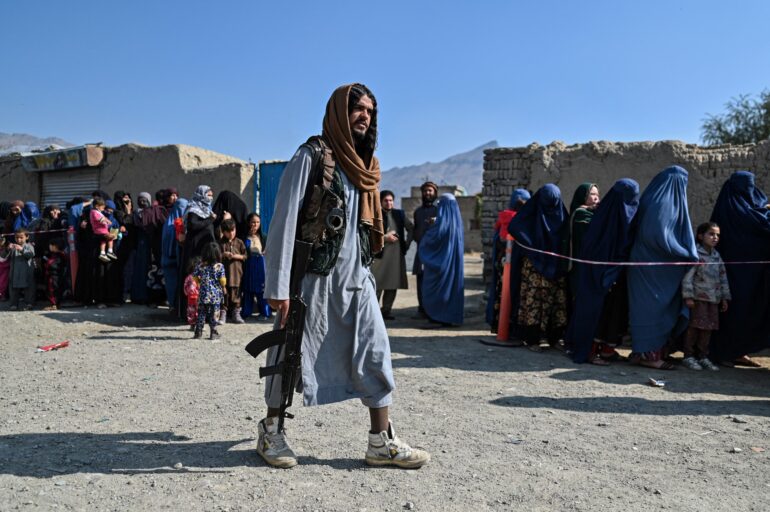

KABUL, AFGHANISTAN – Taliban restrictions on humanitarian access led to the temporary suspension of 18 aid programs in Afghanistan in July, while ongoing limits on women’s participation continued to disrupt the delivery of assistance across the country, the United Nations said in a new report.
In a report released on Thursday, the UN Office for the Coordination of Humanitarian Affairs (OCHA) said humanitarian partners across Afghanistan reported 30 access-related incidents in July, a 50% decline from the 60 incidents recorded in June.
Despite the decrease, Taliban interference remained the most frequently reported obstacle to humanitarian operations, accounting for 16 of the incidents, OCHA said.
The reported cases included interference in the implementation of humanitarian programs, delays and challenges in obtaining approvals, involvement in the selection of aid recipients and requests for staff lists and other sensitive information from humanitarian organizations.
OCHA also reported restrictions affecting the movement of humanitarian workers and supplies, which it said continued to complicate the delivery of assistance to communities in need.
Restrictions affecting women remained another major barrier to humanitarian operations. The agency documented 11 gender-related incidents in July, including restrictions on the participation of female aid workers, requirements for women to be accompanied by a male guardian and restrictions affecting the recruitment and involvement of women in humanitarian activities.
The restrictions have also affected access to aid services, particularly for women and communities where female humanitarian workers are needed to reach women and children.
OCHA also recorded 12 incidents involving violence against humanitarian personnel, assets or facilities during July. These included the detention of aid workers, physical assaults and threats.
According to OCHA, 12 humanitarian workers were detained during the month. The agency said, however, that no humanitarian workers were killed, injured or abducted during the reporting period.
In one incident in Herat, OCHA said the Taliban detained a construction supervisor, a security guard and five workers while temporarily suspending construction activities at a reception centre. Most of those detained were later released, while the construction supervisor remained in detention until July 28, the agency said.
In a separate incident in Herat, two humanitarian workers were detained. OCHA said such incidents, together with reports of threats and physical attacks, continued to raise concerns over the safety and security of humanitarian personnel.
Southern and western Afghanistan recorded the highest number of access-related incidents, with Herat reporting the largest number of cases, according to OCHA.
The restrictions had operational consequences beyond individual incidents. OCHA said 18 reported incidents resulted in the temporary suspension of humanitarian programs, while two led to the temporary closure of humanitarian facilities.
Afghanistan remains heavily dependent on international humanitarian assistance as it faces widespread poverty, unemployment and economic hardship. The United Nations estimates that nearly 22 million Afghans, or almost half of the country’s population, require humanitarian assistance this year.
The humanitarian situation has been further strained by recurrent natural disasters, a significant decline in international funding and the return of more than 6 million Afghans from neighboring countries in recent years.
Humanitarian organizations have repeatedly warned that restrictions on female staff and limitations on access can make it more difficult to reach vulnerable populations, particularly women and children, with essential assistance.

