

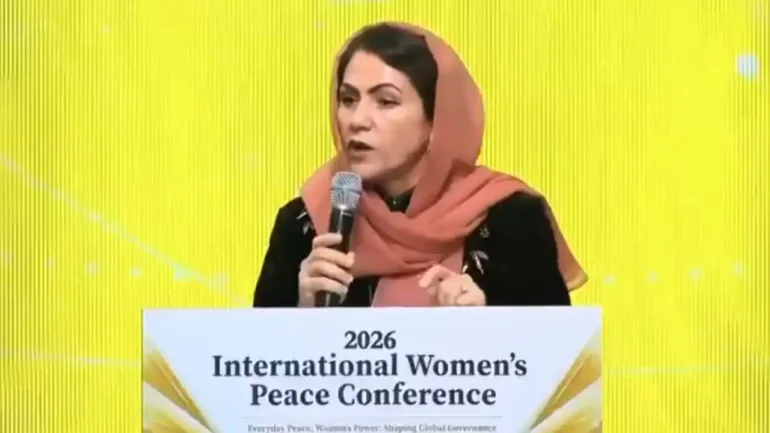

KABUL, AFGHANISTAN – Fawzia Koofi, a former member of Afghanistan’s parliament and a former negotiator in the Afghan peace talks, has said that the Taliban began what she described as a “war against women” following the failure of the country’s peace process, calling the situation facing Afghan women “absolute gender apartheid.”
Koofi made the remarks at the International Women’s Peace Conference in Cheongju, South Korea, where she spoke about Afghanistan, women, peace and security, and lessons from the country’s experience. The two-day conference brought together participants from several countries in Asia, Africa and the Americas.
Reflecting on the different political trajectories of Afghanistan and South Korea, Koofi said the two countries shared a history of struggle and efforts for democracy. She said South Koreans had succeeded in their pursuit of democracy, while Afghans had failed to achieve a similar outcome.
Koofi, who represented the former Afghan government in negotiations with the Taliban in Doha, said the failure of the Afghan peace process had also left Afghan women disappointed with the international community, particularly regarding commitments related to women, peace and security.
She said that after the peace process failed, the Taliban intensified restrictions on women’s education and employment. According to Koofi, the Taliban fear educated women and have therefore sought to prevent them from accessing education and participating in public life.
Koofi also challenged the Taliban’s claim that Afghanistan became secure after their return to power. She argued that peace should not be understood merely as the absence of armed conflict, but should also include dignity, personal security and the ability of people to feel safe in their homes and communities. She said millions of Afghan women do not experience such a sense of security under the current restrictions.
Koofi described Afghan women’s continued resistance to the Taliban’s restrictions as a source of inspiration and said the international community should learn from Afghanistan’s experience. She called for mechanisms to ensure that women are not marginalised when governments and international actors change their political priorities.
She also urged participants to hold their governments accountable after returning home and to use social media to raise awareness about the restrictions imposed on Afghan women. Koofi further called on participants to support efforts aimed at criminalising and ending what she described as gender apartheid in Afghanistan.
Since the Taliban returned to power in August 2021, Afghan women and girls have faced extensive restrictions on education, employment, freedom of movement and participation in public life. The United Nations has said the restrictions affect almost every aspect of women’s lives and pose a major obstacle to Afghanistan’s development and reintegration into the international community.
Girls have been barred from secondary education since 2021, while women have been prohibited from attending universities since December 2022. UN reporting has described Afghan women and girls as being subjected to near-total exclusion from education beyond grade six and from many areas of public life.
Women have also faced increasing restrictions on employment, including restrictions affecting their work with aid organisations and the United Nations. UN agencies and human rights organisations have described these policies as institutionalised discrimination, while efforts to formally recognise the situation as “gender apartheid” have gained international attention.
The Taliban authorities have defended their policies as being consistent with their interpretation of Islamic law and Afghan culture, while the United Nations and numerous human rights organisations have repeatedly called for the restrictions on women and girls to be lifted.

