

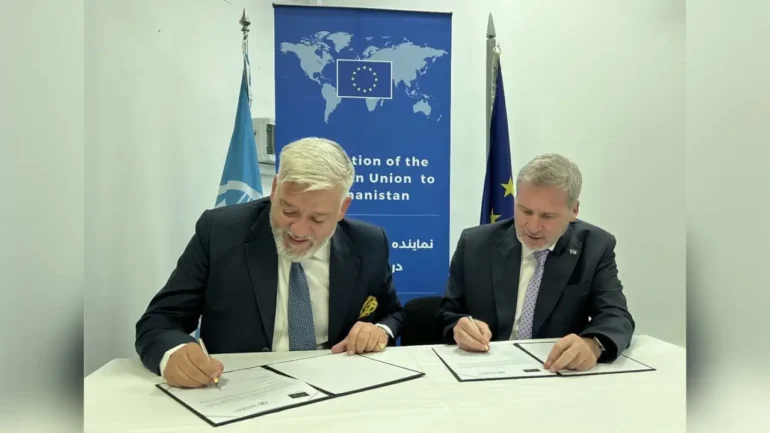

KABUL, AFGHANISTAN – The European Union (EU) and the Food and Agriculture Organization of the United Nations (FAO) have launched a €5 million project aimed at supporting farmers and agribusinesses in Afghanistan, with a focus on climate resilience, food security and rural livelihoods.
In a joint statement on Sunday, September 13, the two organizations said the initiative will support vulnerable households, including returnees, internally displaced people and host communities, in districts facing food and nutrition insecurity, climate risks and limited economic opportunities. Women and young people will be among the key beneficiaries.
The project will establish four one-stop service hubs to connect farmers and rural entrepreneurs with agricultural advice, specialized services, agribusinesses and markets. The hubs will also provide access to climate analysis and early-warning information, allowing farmers to make more timely decisions about production and marketing as weather and other conditions change.
Under the initiative, 2,000 hectares of degraded forests and rangelands will be restored, while 250 nurseries managed by women and local communities will receive support.
The project will also provide matching grants and technical and business advice to agricultural, food-processing and environmentally sustainable businesses with potential for expansion. The EU and FAO said the support is intended to help businesses increase investment, expand processing and services, purchase more products from local farmers and create jobs in rural areas.
Nicola Bellomo, the EU’s chargé d’affaires for Afghanistan, said the project reflects the EU’s continued commitment to food security and the economic empowerment of Afghans. He said Afghanistan’s agricultural potential remains underused because of the country’s high vulnerability to climate-related shocks.
Richard Trenchard, FAO’s representative in Afghanistan, said agrifood businesses have shown potential to grow and create jobs despite the country’s difficult economic environment. He said the initiative would help connect farmers with knowledge, services and markets while supporting agribusinesses to invest and expand.
The new initiative comes as Afghanistan continues to face severe food insecurity and repeated climate shocks. FAO says about 80 percent of Afghans derive their income from agriculture, making the sector central to household livelihoods and food security.
The country’s farmers remain particularly vulnerable to drought, water shortages, floods and other climate-related shocks, while many lack access to quality seeds, irrigation, veterinary services, storage facilities, markets and climate information. FAO says these challenges have been compounded by decades of conflict, economic shocks and chronic underinvestment in rural areas.
According to FAO, about 17.4 million Afghans were projected to face high levels of acute food insecurity between November 2025 and March 2026, including around 4.7 million people facing emergency levels of hunger. Dry conditions and reduced irrigation water availability have also affected agricultural production in several parts of the country.
The EU and FAO said the new project is part of a broader effort to move beyond short-term humanitarian assistance toward more sustainable agricultural development and stronger rural economies.
FAO previously warned that as humanitarian funding declines while food insecurity and malnutrition remain widespread, sustained investment in private sector development and market systems is essential to transforming Afghanistan’s agrifood system, supporting farming communities, stimulating local economies, and building a more food-secure future.

