

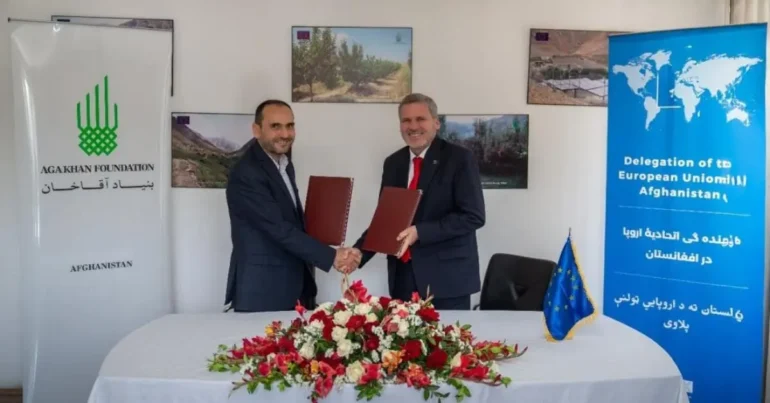

KABUL, AFGHANISTAN – The European Union has announced a €10 million allocation to the Aga Khan Foundation to implement a program in Afghanistan focused on strengthening resilience, inclusive development, economic growth and empowerment.
The EU Delegation to Afghanistan said in a statement that the program, titled “Boosting Resilience, Inclusive Development, Growth and Economic Empowerment (BRIDGE)” has a total budget of €13.5 million, with the remaining funding to be provided by the Aga Khan Foundation.
The 36-month program will be implemented across 10 provinces and aims to strengthen resilience and support the sustainable reintegration of displaced populations, while promoting stability, social cohesion and economic growth.
According to the EU delegation, the initiative is expected to directly benefit 83,197 people and indirectly reach another 582,379 people over the course of the program.
The project will place particular emphasis on young people, women, vulnerable host communities, returnees and internally displaced people, the delegation said.
The program will focus on three key areas: “i) climate resilience and agricultural livelihoods; ii) economic growth and employment; and iii) community resilience and sustainable reintegration.”
Eric Beaume, head of the Cooperation Section at the EU Delegation to Afghanistan, said the agreement would support the livelihoods of Afghans and help address the root causes of migration and forced displacement.
“Today, we concluded an important agreement that will support the livelihoods of Afghan people and help address the root causes of migration and forced displacement. Through this action, we provide economic stabilisation and strengthen the resilience of Afghan communities, enabling them to build sustainable livelihoods and withstand future shocks,” Beaume said.
Dr. Najmuddin Najm, CEO of the Aga Khan Foundation and coordinator of the Aga Khan Development Network in Afghanistan, welcomed the initiative, describing it as another significant step in the longstanding cooperation between the EU and the Aga Khan Development Network in the country.
“Building on the longstanding partnership between the EU and the Aga Khan Development Network (AKDN) in Afghanistan, we are pleased to announce this new initiative, marking another important step in our collaboration in the country,” Najm said.
“This project reflects our shared commitment to supporting vulnerable communities in strengthening socioeconomic stability and creating sustainable livelihoods and economic opportunities across Afghanistan. The AKF Afghanistan expresses its appreciation to the EU for its generous support and is honoured to contribute to this important effort, working alongside its sister agency AKCS to strengthen local economies, build resilient communities and advance sustainable recovery across Afghanistan,” Dr. Najmuddin added.
The EU Delegation and the Aga Khan Foundation did not specify which 10 Afghan provinces will be covered by the program.
Afghanistan’s livelihoods and economic prospects have deteriorated significantly since the Taliban returned to power in August 2021, as the country has faced declining international aid, weak private investment, restrictions on women’s participation in the economy, repeated climate shocks and the return of millions of Afghans from neighboring countries.
The United Nations has previously estimated that more than 17 million people—over one-third of Afghanistan’s population—will face acute food insecurity this year, with women and children disproportionately affected.
Although the economy has recorded modest growth in recent years, that growth has not translated into higher household incomes or improved living standards; the World Bank estimates that GDP per capita fell by 5.6 percent in 2025 amid rapid population growth and large-scale return migration. Agriculture, which remains a major source of employment and income, continues to face drought, water shortages and other climate-related pressures, while farmers and businesses struggle with limited access to finance, markets and infrastructure.
At the same time, unemployment and underemployment remain widespread, particularly among young people, while restrictions on women’s education and economic participation have further reduced the country’s productive capacity. The large-scale return of Afghans from Pakistan and Iran has added further pressure to already weak labor markets, housing, public services and local economies.
Against this backdrop, the EU-backed program could provide targeted support for agricultural livelihoods, employment and small businesses, while helping communities adapt to climate shocks and facilitating the reintegration of returnees and internally displaced people.

