

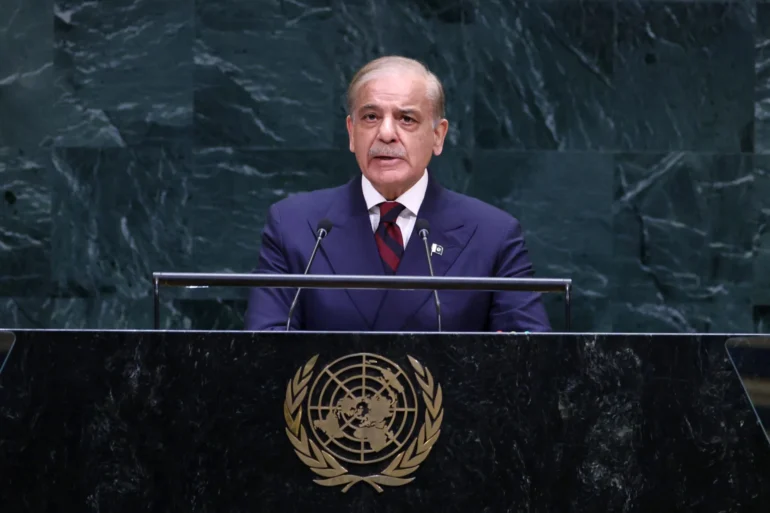

KABUL, AFGHANISTAN – Pakistan’s Prime Minister Shehbaz Sharif has raised the situation in Afghanistan under Taliban control during his address to the United Nations General Assembly, accusing militant groups of using Afghan territory to carry out attacks in Pakistan while also calling for the protection of Afghans’ fundamental rights, particularly those of women and girls.
Sharif said the Tehrik-e-Taliban Pakistan (TTP) and the Balochistan Liberation Army (BLA) were using Afghan territory to conduct attacks inside Pakistan. He called on the Taliban authorities to fulfill their international commitments and take “verifiable” measures to prevent Afghan soil from being used against Pakistan or any other country.
Pakistan has repeatedly made similar allegations against the Taliban authorities, while the Taliban have rejected accusations that they allow Afghan territory to be used for attacks against neighboring countries.
Sharif described terrorism as one of the most serious threats to international peace and security, saying Pakistan had paid a heavy price in its fight against militant groups. He said nearly 100,000 people had been killed and Pakistan had suffered more than $150 billion in economic losses during its counterterrorism efforts.
The dispute over militant activity in Afghanistan has contributed to a sharp deterioration in relations between Islamabad and the Taliban authorities. Pakistan has carried out several airstrikes inside Afghanistan, saying they targeted militant hideouts and training facilities.
In the latest strikes on September 21, Pakistan said its forces killed 28 militants in operations in Afghanistan’s Kunar and Paktika provinces. Taliban authorities, however, reported civilian casualties, while the UN Assistance Mission in Afghanistan (UNAMA) confirmed that at least three civilians — a man, a woman and a girl — were killed and four others wounded in Kunar.
The Taliban condemned the strikes as violations of Afghanistan’s sovereignty and said they would respond. Pakistan, meanwhile, has maintained that its military operations are directed at militant targets and has accused groups operating from Afghan territory of being responsible for attacks inside Pakistan.
The latest escalation comes amid a broader deterioration in bilateral relations. Pakistan closed major border crossings with Afghanistan in October 2025, citing security concerns, and bilateral trade and transit were subsequently disrupted. Pakistan’s mission to the UN said in September that trade and transit remained suspended and that visa issuance to Afghans had also been affected by the continuing dispute.
UNAMA has warned of the growing civilian cost of cross-border violence. A UN-focused September assessment reported 399 civilian casualties — 57 deaths and 342 injuries — from cross-border armed violence during the period it reviewed, including women and children.
The impact of these attacks has also been documented by Afghan human rights organizations. A report published by Afghan human rights organization Rawadari on July 27 documented at least 1,187 civilian casualties from Pakistani military operations in Afghanistan between December 2024 and June 2026.
The figure includes 472 civilians killed and 715 injured, among them 216 children and 169 women. Rawadari documented around 50 Pakistani attacks across at least nine Afghan provinces, including airstrikes, rocket and ground attacks, and combined operations. The organization also reported that the attacks forced around 29,000 families to flee their homes and caused significant damage to civilian infrastructure.
The tensions between the two countries have therefore expanded beyond disputes over militancy, affecting border security, trade, transit and civilian life. While Islamabad has demanded action against armed groups it says operate from Afghanistan, Taliban authorities have accused Pakistan of violating Afghan sovereignty through cross-border military operations.

