


KABUL, AFGHANISTAN – The human rights organization Rawadari on Monday, July 27, 2026, has published a new investigative report examining the consequences of Pakistan’s military attacks inside Afghanistan between December 2024 and June 2026.
The report, titled “Examining the Consequences of Pakistan’s Military Attacks on Civilians in Afghanistan,” documents widespread civilian casualties, destruction of civilian infrastructure, displacement, and possible violations of international humanitarian law.
According to the report, Pakistani military operations during this period resulted in at least 1,187 civilian casualties, including deaths and injuries, while forcing around 29,000 families to leave their homes.
The report is based on field investigations, interviews with victims, witnesses, and local residents, as well as information gathered from local officials, humanitarian organizations, media reports, and other available sources.
Rawadari states that the findings were assessed under the principles of international humanitarian law, particularly the principles of distinction, proportionality, and precaution, which require armed forces to differentiate between civilians and military targets, avoid excessive civilian harm, and take necessary measures to reduce civilian casualties during military operations.
The publication of the report comes amid growing tensions between Pakistan and Afghanistan following an increase in cross-border attacks and military confrontations after late 2024.
Rawadari states that tensions intensified after attacks by Tehrik-e-Taliban Pakistan (TTP) against Pakistani security forces. Pakistan accused the Afghan Taliban authorities of allowing TTP members to operate from Afghan territory, while the Taliban rejected these accusations. Following these disputes, Pakistan carried out a series of military operations inside Afghanistan, including airstrikes, ground assaults, and rocket attacks in several provinces.
Rawadari’s investigation found that Pakistan conducted military operations in at least nine Afghan provinces, including Paktia, Paktika, Khost, Nuristan, Kunar, Nangarhar, Kandahar, Helmand, and Kabul. The organization documented approximately 50 attacks carried out through different methods, including air operations, ground and rocket attacks, and combined air and ground operations.
According to the report, 19 of the documented attacks, representing about 38 percent of the total incidents, were airstrikes mainly carried out using fighter aircraft and armed drones. Meanwhile, 28 attacks, accounting for around 56 percent of the documented operations, involved ground and rocket attacks launched from Pakistani military positions near the border using rockets, missiles, mortars, and other weapons.
In addition, three incidents, or around 6 percent of the total attacks, involved combined air and ground operations conducted simultaneously or consecutively in areas such as Asadabad city and Sarkano district in Kunar Province and Spin Boldak district in Kandahar Province.
Rawadari states that these attacks caused the deaths of 472 civilians and injuries to another 715 people. The report provides details of the casualties, stating that those killed included 342 men, 86 children, and 44 women, while those injured included 460 men, 130 children, and 125 women. The organization says that many victims were ordinary civilians who were not involved in armed activities and that several families lost multiple members in individual attacks.
The report also highlights concerns regarding the timing and circumstances of the attacks. Rawadari says that 31 of the documented attacks were carried out during the early morning hours or at midnight, when many residents were inside their homes or asleep. The organization says that in some cases, areas were attacked more than once within a short period, with follow-up attacks occurring while civilians were attempting to escape, rescue injured people, or recover victims from previous strikes.
Furthermore, Rawadari states that many attacks were carried out without prior warnings to civilians. Based on interviews conducted for the report, 21 people said they had received no warning or information before the attacks and therefore had no opportunity to leave the area or seek safety. Only one interviewee, a daily wage worker at a government institution, reported receiving a warning after observing Pakistani military aircraft before an attack. The organization argues that the lack of effective warnings and precautionary measures contributed to increased civilian casualties.
The report also raises questions about whether many of the targeted areas contained legitimate military objectives. According to Rawadari, information collected from witnesses and local sources indicates that several attack sites were located far from known military installations. Seventeen interviewees told the organization that there were no recognized military facilities or positions near the locations that were struck.
Based on these findings, Rawadari argues that some attacks may have failed to comply with the principle of distinction under international humanitarian law.
One of the most serious incidents documented in the report was an airstrike on Camp Omid, a drug treatment and rehabilitation center in Kabul. Rawadari states that Pakistan claimed the facility was targeted because it was allegedly being used for military purposes; however, the organization concluded that the center was a civilian facility and that the victims were civilians, including patients, visitors, and employees.
According to Rawadari, at least 204 men were killed and 96 people, including one woman, were injured in the attack. The organization says that the identities and details of victims were collected from 10 hospitals in Kabul, including forensic medicine facilities, and that most of those affected were patients, visitors, and staff members of the rehabilitation center.
Rawadari also referred to previous figures released by the United Nations Assistance Mission in Afghanistan (UNAMA), which reported 269 deaths and 122 injuries from the incident. However, Rawadari noted that the final number of victims remains unclear because of the scale of destruction, the intensity of the explosions, and the possibility that some people remain missing. The organization stated that the attack could represent a violation of international humanitarian law and may require further investigation.
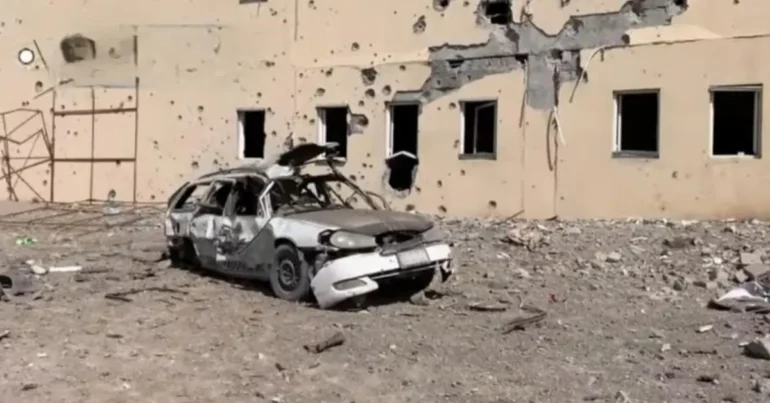
In addition to civilian casualties, Rawadari documented extensive destruction of residential areas and public infrastructure. The report states that at least 394 civilian homes were completely or partially destroyed during Pakistan’s military operations. Among these, 170 houses were damaged in Paktika Province, 104 in Kunar, 57 in Kandahar, 53 in Khost, six in Nangarhar, three in Paktia, and one in Kabul city.
The destruction also affected essential public facilities. Rawadari reported that at least 22 schools, one hospital, one health clinic, 11 mosques, 46 shops, and 10 vehicle dealerships were either completely destroyed or partially damaged in several provinces. The organization said that attacks on civilian infrastructure had serious consequences for local communities, limiting access to education, healthcare, and basic services.
According to the United Nations Office for the Coordination of Humanitarian Affairs (OCHA), attacks on civilian infrastructure caused around 19 health facilities to suspend operations or reduce services, affecting approximately 78,000 people who lost or experienced reduced access to healthcare. In addition, more than 13,000 students in Kunar and Nangarhar provinces faced disruptions to their education because of damage caused by military operations.
The report further emphasizes the humanitarian consequences of the attacks, stating that thousands of families experienced displacement, economic losses, food insecurity, and psychological distress.
Around 29,000 families from Paktia, Paktika, Kunar, Khost, Nuristan, Nangarhar, Kandahar, and Helmand were forced to leave their homes due to military operations. Many displaced residents lost their houses, farms, businesses, and sources of income, leaving them dependent on humanitarian assistance.
Rawadari also documented the impact of military operations on transportation and access to essential services. One example mentioned in the report was the closure of the only road connecting Kamdesh and Bargi Matal districts in Nuristan Province for more than two months. The organization said the blockade prevented civilians from accessing food, medical services, and other basic necessities.
In its legal assessment, Rawadari examined the documented incidents through the framework of international humanitarian law. The organization argues that several attacks raised serious concerns regarding the principle of distinction because civilian areas and facilities were allegedly targeted without clear evidence of military objectives.
It also stated that some attacks may have violated the principle of proportionality due to the scale of civilian harm compared with any claimed military advantage. Additionally, Rawadari concluded that insufficient precautions, including the failure to provide effective warnings, contributed to civilian suffering.
At the conclusion of the report, Rawadari called on Pakistan to immediately stop military actions that result in civilian casualties and ensure that all future operations comply with international humanitarian law.
The organization also called for independent investigations into alleged violations, compensation and assistance for victims and their families, and stronger action by the United Nations and the international community to protect civilians and ensure accountability.
Overall, Rawadari’s report presents Pakistan’s military operations in Afghanistan between December 2024 and June 2026 as having caused significant humanitarian, social, and economic consequences for Afghan civilians. The organization warns that continued attacks affecting civilian communities could further deepen the suffering of affected populations and emphasizes the urgent need for protection, justice, and accountability.

