

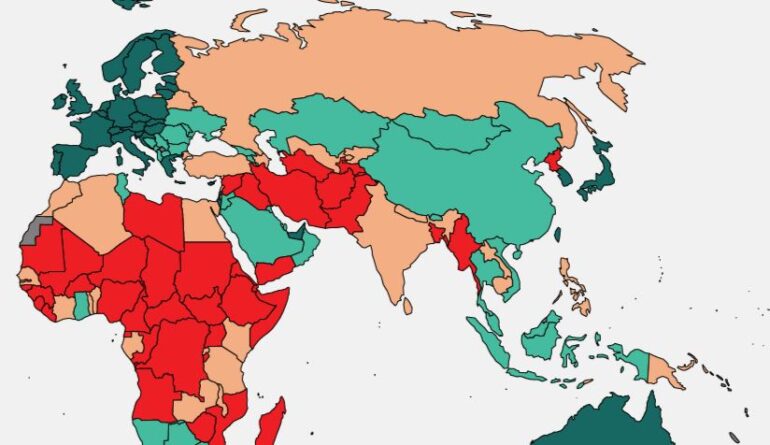

KABUL, AFGHANISTAN – Afghanistan’s performance on positive peace deteriorated by 3.3% over the past decade, making it the only South Asian country to record a decline between 2015 and 2024, according to the 2026 Positive Peace Report by the Institute for Economics & Peace (IEP).
Afghanistan ranked 157th among 163 countries, with a score of 4.19, placing it in the report’s “Low” positive peace category. The country ranked below Eritrea and above the Democratic Republic of Congo, Yemen, Chad, the Central African Republic, South Sudan and Somalia.
Positive Peace is a measure developed by the IEP to assess the attitudes, institutions and structures that create and sustain peaceful societies. It focuses on the conditions that enable societies to maintain peace, develop resilience and support human potential, rather than simply measuring the absence of violence. The index covers 163 countries and is based on statistical assessments of more than 20,000 indicators, covering 99.7% of the world’s population.
The report said Afghanistan’s deterioration was driven primarily by sharp declines in indicators associated with political openness and the flow of information.
Freedom of the press deteriorated by 78.8% between 2015 and 2024, the largest decline recorded in any single indicator in South Asia, the report said. The quality of information deteriorated by 23.4%, while laws supporting equal treatment of population groups declined by 25%.
Other areas also recorded significant deterioration. The indicator measuring exclusion by socioeconomic group worsened by 20.4%, while government effectiveness declined by 13.2%, according to the report.
Afghanistan’s performance contrasted with the broader trend in South Asia, where the average Positive Peace score improved by 2.9% between 2015 and 2024. Sri Lanka recorded a 6.3% improvement, followed by India at 6%, Nepal at 4.7%, Bhutan at 4.1%, Bangladesh at 3.5% and Pakistan at 0.9%. Afghanistan was the only country in the region to deteriorate.
Denmark ranked first globally, followed by Finland, Sweden, Switzerland and Norway. At the bottom of the table are Somalia in 163rd place, South Sudan in 162nd, the Central African Republic in 161st, Chad in 160th and Yemen in 159th. Pakistan ranked 135th, while Iran ranked 124th.
The IEP assesses Positive Peace through eight broad pillars: well-functioning government, sound business environment, equitable distribution of resources, acceptance of the rights of others, good relations with neighbors, free flow of information, high levels of human capital and low levels of corruption.
Globally, Positive Peace improved by 1.7% between 2015 and 2024, with 112 of 163 countries recording improvements and 49 deteriorating. The report said much of the global improvement was driven by telecommunications infrastructure, which improved by 36.8% across the decade. Without that indicator, the global index would have deteriorated by 0.1%.
The report said the countries that made the greatest gains in internal peace over the past decade also tended to record greater improvements in Positive Peace, particularly in areas linked to governance, social cohesion, the rule of law and control of corruption.
For Afghanistan, however, the report identified deterioration in information, political openness, equal treatment, social inclusion, and government effectiveness as key factors behind its worsening Positive Peace score.

