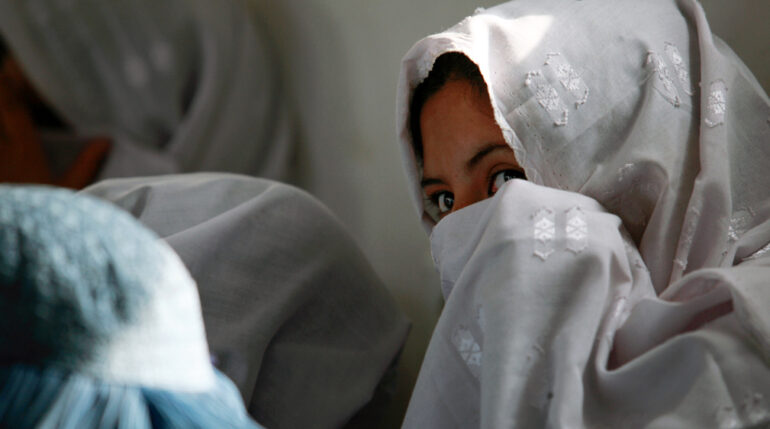

KABUL, AFGHANISTAN – As Afghanistan approaches the fifth anniversary of the Taliban’s return to power, the United Nations Educational, Scientific and Cultural Organization (UNESCO) says approximately 2.4 million girls have been deprived of education in the country since 2021.
In a report published Tuesday, August 11, UNESCO said women have also been barred from attending universities since 2022 and continue to face severe restrictions on employment and participation in public life.
The UN agency said Afghanistan is the only country in the world where girls and women are formally prohibited from attending secondary school and pursuing higher education.
UNESCO warned that the restrictions risk depriving Afghanistan of its human potential for decades, deepening poverty and causing irreversible damage to the country’s social and economic development.
The agency estimates that the ban on girls’ and women’s education could result in as many as 600,000 women leaving the labor market by 2066, while cumulative income losses could reach $9.6 billion. It also warned that the restrictions could increase the risk of early marriage.
UNESCO said the ban on women’s access to higher education would further exacerbate the shortage of female teachers. According to the agency, more than two million primary-school-age children are also out of school for reasons unrelated to the restrictions imposed on girls and women.
UNESCO estimates that Afghanistan could face a shortage of more than 11,000 qualified female teachers by 2030.
Hoda Jebran, UNESCO’s Education in Emergencies Program Coordinator, said during a press briefing that many teachers had left the country, while others who remained in the education system had been prevented from continuing to teach.
She said the ban on women teaching boys has pushed many qualified female teachers out of the education system, leaving boys to be taught either by unqualified male teachers or, in some cases, without teachers altogether.
UNESCO also said that more than 90 percent of 10-year-old children in Afghanistan are unable to read a simple text, while the country’s literacy rate stands at just 37 percent.
After returning to power, the Taliban first banned girls above sixth grade from attending school before closing universities and medical institutes to women. Despite widespread international condemnation of the restrictions over the past five years, the Taliban has refused to reverse its policies.
Despite the restrictions, UNESCO said it continues to work to prevent the collapse of education in Afghanistan.
The agency said it is providing alternative learning opportunities through community-based literacy programs, skills training and psychosocial support.
Shahla, a 28-year-old participant in a UNESCO-supported literacy and sewing program in Nuristan, said the initiative had transformed her life.
“This programme changed my life. Learning to read changed everything. For the first time, I could write down sewing steps myself and practice them at home until I mastered them. My only wish is that every girl in our community be given the same chance.”
UNESCO said more than 69,000 people have benefited from its education programs since 2021, with women accounting for 73 percent of participants.
UNESCO has played a longstanding role in supporting Afghanistan’s education sector, having worked in the country since Afghanistan joined the organization in 1948. Over the past two decades, the agency supported nationwide literacy initiatives, education-sector reforms, teacher development and efforts to expand access to learning, particularly for women and girls.
Since the Taliban’s return to power in 2021, UNESCO has shifted much of its focus toward protecting the right to education and maintaining alternative learning opportunities for those excluded from the formal education system. Its programs include community-based literacy classes, vocational and livelihood skills training, teacher support, education data collection and alternative forms of learning through radio, television and digital platforms.
In 2026, UNESCO also launched a new initiative with Sweden’s development agency to expand alternative education and strengthen pathways from learning to employment and entrepreneurship for Afghan girls and women. Despite these efforts, UNESCO continues to stress that alternative programs cannot substitute for the full restoration of girls’ and women’s access to formal education.