

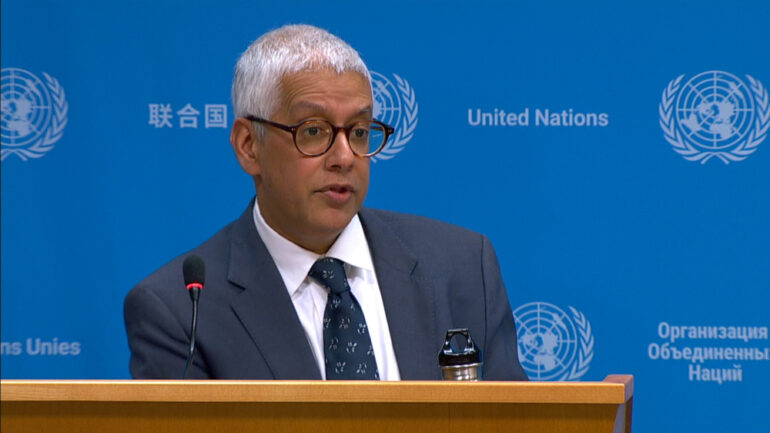

KABUL, AFGHANISTAN – Farhan Haq, Deputy Spokesperson for the United Nations Secretary-General, says there is currently no movement among UN member states to transfer Afghanistan’s seat at the United Nations to the Taliban.
Speaking at a press briefing on Tuesday (August 4), Haq responded to a question about the conditions for granting Afghanistan’s UN seat to the Taliban, saying that decisions on recognition are made by individual governments.
He said that the decision on recognizing a government is made by individual countries, not by the United Nations, and that no such recognition has been granted to the Taliban as the de facto authorities of Afghanistan.
Haq added that, to his knowledge, there is no initiative underway among member states to change Afghanistan’s representation at the United Nations.
Nearly five years after the Taliban seized power in Afghanistan, only Russia has formally recognized the group as the country’s government, although several other countries maintain diplomatic relations with Kabul. Afghanistan’s UN seat remains occupied by a diplomat appointed by the previous government, and the Taliban’s efforts to take control of the seat have so far been unsuccessful.
Several countries have linked possible recognition of the Taliban to conditions including respect for human rights, particularly women’s rights, counterterrorism commitments, and the establishment of an inclusive government.
Since the Taliban returned to power in August 2021, the group has imposed sweeping restrictions on women and girls, effectively barring them from secondary and higher education, many forms of employment, and broad participation in public life. Women are also required to adhere to strict dress codes and need a male guardian for long-distance travel.
UN experts, international human rights organizations, and activists have described the systematic policies as “gender apartheid,” arguing they deliberately subjugate women and girls solely on the basis of gender. They have repeatedly called on the United Nations and world leaders to recognize gender apartheid as a crime against humanity under international law, though no formal legal proceedings have been launched to date.
The Taliban authorities defend their policies as consistent with their strict interpretation of Islamic law and have given no indication they intend to relax the measures despite mounting international criticism and pressure.
Afghanistan continues to face serious terrorism and security challenges despite the Taliban’s claims of improving stability. Armed groups, including ISIS-K (Islamic State Khorasan), remain active and have carried out attacks targeting civilians, religious minorities, and security personnel.
Reports by the United Nations Security Council’s sanctions monitoring team have confirmed the presence of both the Tehrik-i-Taliban Pakistan (TTP) and the East Turkestan Islamic Movement (ETIM) in Afghanistan.
Meanwhile, the Taliban have rejected calls for an inclusive government, describing such demands as interference in Afghanistan’s internal affairs. The group has claimed that its current administration, which is largely made up of Taliban and Pashtun members, represents an inclusive government.

