

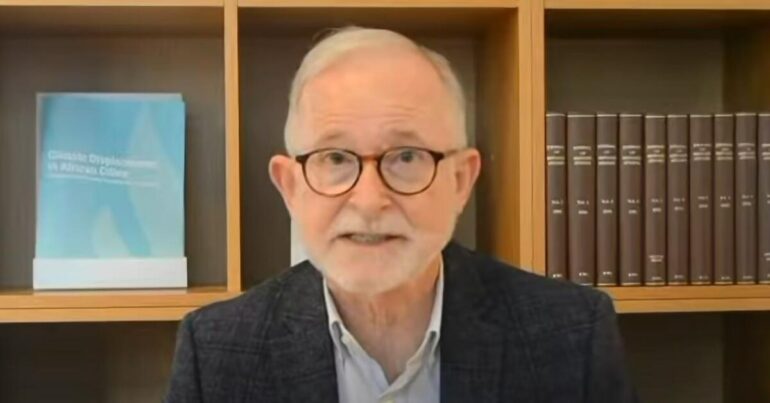

KABUL, AFGHANISTAN – Richard Bennett, the UN Special Rapporteur on the human rights situation in Afghanistan, and other UN human rights experts have warned against the growing international push to normalize relations with the Taliban, saying such engagement risks legitimizing the group’s systematic repression.
In a joint statement issued ahead of the fifth anniversary of the Taliban’s return to power, the experts said they were repeating their warning from a year ago with greater urgency, as efforts to normalize relations with the Taliban have increased while the conditions that could justify such a move have not changed.
“Normalising a regime that systematically persecutes more than half of its population does not promote change; it legitimises oppression,” the experts said.
Bennett and the other experts said it remains premature to invite Taliban representatives to foreign capitals or accept their diplomats, arguing that such steps amount to de facto recognition. They called on states to refrain from normalizing relations with the Taliban unless there is “demonstrated, measurable and independently verified progress” on human rights, particularly the rights of women and girls.
They said the same standard should apply to engagement facilitated or convened by the United Nations and stressed that no process concerning Afghanistan’s future should proceed without the full and meaningful participation of Afghan women.
The experts said that over the past five years, the Taliban have established an expanding system of edicts and institutional controls that has affected almost every aspect of public and private life. They reiterated that the institutionalized system of gender-based discrimination, domination and oppression amounts to the crime against humanity of persecution on grounds of gender and can also appropriately be described as gender apartheid.
According to the statement, the ban on girls’ education beyond grade six has now lasted five years, while women and girls remain excluded from many forms of employment and face restrictions on movement, healthcare, justice, sports, cultural activities, public spaces and public affairs.
The experts said institutions that previously provided protection and support to women and children have been dismantled or weakened, leaving many women and girls exposed to greater risks of abuse and exploitation.
They also expressed concern over child and forced marriage, restrictions on women’s access to healthcare and the detention of women and girls over their clothing. The experts said corporal and capital punishment also continue under Taliban rule.
In 2025 alone, they said, the Taliban’s de facto Supreme Court announced the flogging of at least 1,110 people, including at least 170 women, while at least 12 men have been publicly executed since the Taliban returned to power in August 2021.
The experts stressed that repression under the Taliban extends beyond women and girls. They said religious minorities, including Shia Muslims, Sikhs, Hindus, Baha’is and Christians, face discrimination and persecution, while LGBT+ people face severe abuses and people with disabilities are excluded from education, healthcare and livelihoods.
Journalists, educators, judges, lawyers, human rights defenders and former government officials have also faced detention, harassment and other forms of punishment, according to the statement.
The UN experts said civic space has been severely restricted, with women human rights defenders facing arbitrary detention, harassment, home raids and torture or ill-treatment. They also warned that the Taliban’s restrictions on the media have intensified through new edicts, continued detention of journalists and censorship.
The statement also raised concerns about the forced return of Afghans from neighboring countries and Europe. The experts said Afghanistan is not a safe country for deportation, particularly for groups facing heightened protection risks, including LGBT+ people, those perceived to have links with the former Islamic Republic and human rights defenders. They said millions of Afghans have been returned from Iran and Pakistan, some forcibly, while European governments have also expressed plans to organize returns to Afghanistan.
The UN experts also drew attention to Afghanistan’s worsening humanitarian crisis. They said more than 17 million people, or more than one-third of the population, faced acute food insecurity during the past winter, while nearly four million children were acutely malnourished. They attributed the crisis to a combination of drought, economic decline, reduced humanitarian funding and the return of more than 2.5 million Afghans from neighboring countries.
The experts said women and female-headed households are disproportionately affected because restrictions on movement, employment and access to services make it more difficult for them to earn income or receive humanitarian assistance.
Calling for stronger international action, the experts urged states to combine pressure for accountability with humanitarian assistance, support for civil society and protection for Afghan refugees and displaced people. They welcomed the establishment of the Independent Investigative Mechanism for Afghanistan by the UN Human Rights Council in October 2025, but said it must receive sufficient resources, staffing and gender expertise and ensure meaningful participation by Afghan civil society, particularly women.
They also urged states to support efforts to codify gender apartheid as a distinct crime against humanity and to maintain humanitarian funding while ensuring that women and women-led organizations can both deliver and receive assistance.
The experts noted that the International Criminal Court has issued arrest warrants for the Taliban’s Supreme Leader and Chief Justice over the alleged crime against humanity of gender persecution, and called for strong international support for accountability efforts.
Five years after the Taliban’s return to power, the experts said the international community should not allow normalization to advance without measurable human rights improvements. They warned that a regime built on systematic human rights violations and entrenched repression cannot deliver lasting stability and that engagement without clear conditions will not bring security or peace to Afghanistan.
The experts called on the Taliban to respect Afghanistan’s international human rights obligations, reverse policies that violate fundamental rights and end the forced imposition of a single model of society on Afghanistan’s diverse population.

