

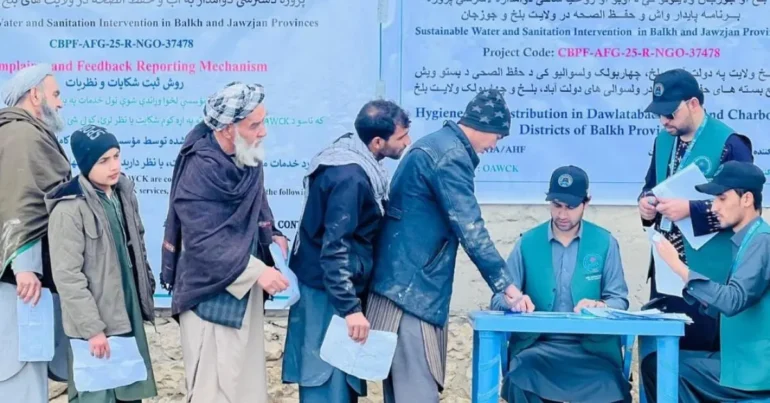

KABUL, AFGHANISTAN – The United Nations Office for the Coordination of Humanitarian Affairs (OCHA) says humanitarian organizations provided at least one form of assistance to 7.4 million people in Afghanistan between January and June 2026.
In a report, OCHA said the level of coverage was significant given the amount of funding received for humanitarian operations.
According to the UN agency, 62 percent of those reached—equivalent to 4.6 million people—received food assistance.
OCHA said the figure reflects both the widespread prevalence of acute food insecurity in Afghanistan and the significant role of food assistance in determining the overall number of people reached by humanitarian organizations.
Meanwhile, the United Nations says humanitarian operations in Afghanistan continue to face a severe funding shortfall.
Of the $1.71 billion required for humanitarian operations, $1.42 billion, or 83 percent, remains unfunded, according to OCHA.
The agency also said that of the $465 million identified as the most urgent funding requirement under the humanitarian needs plan, 37 percent has yet to be secured.
The report comes amid growing concerns over Afghanistan’s food insecurity. The United Nations has previously estimated that more than 17 million people—over one-third of Afghanistan’s population—will face acute food insecurity this year, with women and children disproportionately affected.
UN agencies say nearly 14 million people in Afghanistan are currently facing hunger.
According to projections by the World Food Programme (WFP), nearly 3.7 million children in Afghanistan are expected to suffer from acute malnutrition this year, while an estimated 1.2 million pregnant and breastfeeding women are also expected to face malnutrition.
The UN appealed for $1.71 billion to address humanitarian needs in Afghanistan in 2026, but less than 20 percent of the required funding had been received by the first half of the year.
Humanitarian agencies have also been hit by a sharp decline in foreign assistance from the United States, which previously financed up to 40 percent of humanitarian aid for Afghanistan.
As a result, aid organizations have been forced to scale back programs and prioritize assistance for those in the most critical need.
According to Human Rights Watch, the country’s food security has continued to deteriorate. Before October 2025, only 28 percent of Afghan households had sufficient access to food without external assistance. By April 2026, that figure had fallen to just 20 percent, while approximately 22 million people now require urgent food and healthcare assistance.
Afghanistan’s humanitarian crisis is being driven by Taliban restrictions on women, the continued deportation of Afghan migrants from neighboring countries, climate change and natural disasters, and declining humanitarian aid. Together, these pressures are worsening poverty, food insecurity and unemployment in an already fragile economy.

