

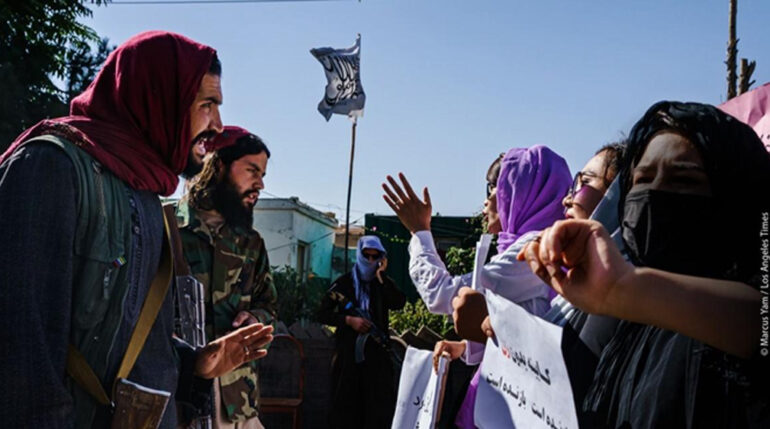

KABUL, AFGHANISTAN – The Taliban have formally banned all demonstrations across Afghanistan under a new police law issued by the group’s Ministry of Justice.
The law, titled the “Police Law” or “Qanun-e Shurta,” was published on Saturday, August 22, by the Taliban’s Ministry of Justice. The law was drafted under the authority of Taliban supreme leader Hibatullah Akhundzada and replaces the term “police” with “Shurta.”
Article 50 of the law explicitly prohibits all forms of demonstrations across Afghanistan.
The law provides no further explanation regarding the ban or whether any exceptions would apply.
The prohibition comes after nearly five years of the Taliban systematically suppressing public protests and arresting demonstrators. Since returning to power in August 2021, the group has repeatedly detained protesters, particularly women who have taken to the streets to oppose restrictions on women’s rights, education and freedom of expression.
Details of the Taliban’s Police Law
The new Police Law consists of five chapters and 53 articles, with the Taliban’s Ministry of Interior designated as the authority responsible for implementing it.
The law outlines the duties and powers of the “Shurta,” or police, as well as the responsibilities of security officials, courts and restrictions imposed on individuals.
Among the duties assigned to the police are maintaining security and public order, securing airports and their facilities, preventing the possession and use of unauthorized weapons and ammunition, taking measures to rescue people during accidents and emergencies, and protecting people’s property and assets.
The Taliban use their own fighters as police and security personnel. Many of the group’s fighters have limited formal education or have graduated from religious schools. In some provinces, the Taliban have organized literacy courses for their fighters.
Under the new law, “Shurta” refers to individuals who assist the head of the police in security-related matters, obey his orders and enforce Taliban government directives concerning security and public order.
The law defines the “Sahib al-Shurta,” or security official, as a person appointed by the Taliban leader within the Ministry of Interior to maintain security and order in the capital and provinces.
The law also defines a “crime” as an act that has been ordered or prohibited by Taliban authorities in matters related to security and public order.
Law Prohibits Beating Suspects With Sticks and Cables
The Taliban’s police law states that police officers must avoid actions that could harm the physical well-being or dignity of suspects and accused persons during arrests.
It further states that no person is permitted to beat a prisoner or accused person with sticks, whips or cables, or otherwise torture them without a judicial order.
The provision comes despite repeated reports over the past five years of violent treatment of detainees by Taliban forces. The group has also been accused of killing people accused of crimes such as theft. More than 10 people have reportedly been killed by the Taliban in Kabul alone in recent months.
The Taliban have also faced allegations of killing prisoners of war. Most recently, the group killed a commander and several members of the National Resistance Front of Afghanistan in an ambush in the Salang area.
There have also been repeated allegations of torture inside Taliban-run prisons.
The new law states that police officers cannot punish prisoners—including political and criminal detainees—inside prisons without a final court ruling.
Rules on Summoning and Arresting Individuals
The law sets out procedures for summoning, arresting and detaining individuals.
According to the law, police may arrest a person following a complaint from an individual affected by a crime, after investigating the complaint and establishing the alleged offense. Police may also make an arrest based on a judge’s order or to enforce the provisions of the law.
If a person fails to appear after receiving an official summons, police may take further steps to compel the person to appear.
The law states that an individual may be detained if they are caught committing an apparent crime or if there is strong evidence against them, including testimony from one credible witness or two witnesses whose circumstances are considered acceptable under the Taliban’s interpretation of Islamic law.
Police may keep a suspect under surveillance or detention when there is a risk that the suspect could endanger another person’s life, when establishing the suspect’s identity is considered necessary for security reasons and the person cannot provide identification documents, or when there are compelling indications that the suspect may attempt suicide.
At the same time, the law says police cannot detain a person on the basis of unsubstantiated information or without sufficient evidence, documents or credible indications.
The law allows police to detain a suspect for up to 10 days for the purpose of investigating a crime. If additional time is required, police must obtain permission from a court to extend the detention.
Conditions for the Use of Firearms
Article 39 of the law sets out circumstances in which police officers may use firearms.
It states that police may use their weapons during what the Taliban describe as “rebellion” and armed crimes against security, as well as during armed conflict.
The Taliban use the term “rebellion” to describe armed opposition to their rule and refer to their armed opponents as “rebels.”
Taliban officials have repeatedly said that individuals who oppose their government are “deserving of death,” raising concerns about how the new provisions could be interpreted and applied against political and armed opponents.
Security Officials Given Authority to “Discipline” Accused Persons
The law also gives Taliban security officials powers to subject accused individuals to what it describes as disciplinary measures.
Under the law, security officials may pressure accused persons to repent by reminding them of God, reprimanding them and using harsh or intimidating language.
Article 41 also states that security officials may threaten individuals accused of serious crimes with death.
The provision further says that repeat offenders involved in major criminal offenses who fail to reform and whose actions cause continued harm or distress to the public should be referred to court and punished in accordance with the Taliban’s criminal regulations.
The explicit prohibition of demonstrations marks a further restriction on public space and freedom of expression under Taliban rule. Demonstrations have historically been one of the few ways for Afghans—particularly women and civil society activists—to publicly challenge government policies and demand their rights.
By formally prohibiting all demonstrations, the Taliban’s new law removes the legal basis for peaceful public protest and gives security authorities a broad framework for preventing gatherings deemed contrary to the group’s rules.
The law also comes amid continued restrictions on freedom of expression, political activity and independent civil society organizations in Afghanistan. The combination of a blanket ban on demonstrations and expanded police powers could further limit the ability of Afghans to publicly criticize Taliban policies or demand accountability.
For women, who have already faced severe restrictions on education, employment, movement and public participation, the ban could further narrow the remaining avenues for peaceful resistance and collective expression.

