

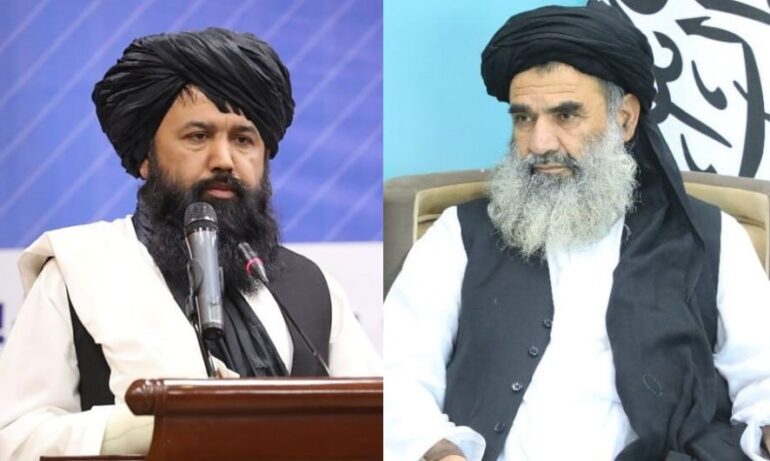

KABUL, AFGHANISTAN – The International Criminal Court (ICC) on Monday made public arrest warrants for two Taliban ministers, accusing them of crimes against humanity, including the gender-based persecution of women, girls and others who do not conform to the group’s gender policies.
The warrants for Taliban Education Minister Habibullah Agha and Higher Education Minister Neda Mohammad Nadim were issued in September 2025 but remained under seal until Monday, the court said in a press release.
The ICC had previously issued arrest warrants on July 8, 2025, for Taliban Supreme Leader Hibatullah Akhundzada and Abdul Hakim Haqqani, head of the Taliban’s Supreme Court, over the same alleged crime.
The ICC said its Pre-Trial Chamber II found reasonable grounds to believe that the four suspects were criminally responsible for ordering, inducing or soliciting the crime against humanity of persecution under Article 7(1)(h) of the Rome Statute, the treaty that established the court.
According to the court, the persecution was carried out on gender grounds against girls, women and other people whose gender, gender identity or expression was considered incompatible with Taliban policies, as well as on political grounds against people perceived as “allies of girls and women”.
The alleged crimes were committed from the Taliban’s return to power on 15 August 2021 up until at least 20 January 2025, a period marked by sweeping restrictions, particularly targeting women and girls.
The court said the four individuals, acting on behalf of the Taliban, had implemented policies that resulted in severe violations of the fundamental rights and freedoms of Afghanistan’s civilian population, including murder, imprisonment, torture, rape and enforced disappearance.
“While the Taliban have imposed certain rules and prohibitions on the population as a whole, they have specifically targeted girls and women by reason of their gender, depriving them of fundamental rights and freedoms,” part of the court’s statement reads.
The ICC said the Taliban, through decrees and edicts, severely deprived girls and women of rights to education, privacy and family life, as well as freedoms of movement, expression, thought, conscience and religion.
Taliban chief spokesperson Zabihullah Mujahid condemned the court’s decision. He claimed the named individuals “committed no act that would make them liable to arrest or punishment.” In a statement, Mujahid said: “Afghanistan does not recognize any court under the title of the ‘International Court,’ nor does it attach any significance to its positions. We are bound by the rulings of Islamic Sharia and its courts, not by intelligence entities or so-called courts.”
The Taliban have previously rejected the Rome Statute, under which the ICC was established, and said they do not consider themselves bound by its provisions.
The ICC has jurisdiction over alleged crimes committed on the territory of Afghanistan because Afghanistan became a party to the Rome Statute in 2003. The court’s investigation into the situation in Afghanistan was formally authorized in 2022 following a decision by its Appeals Chamber.
The arrest warrants do not amount to convictions. Under ICC procedures, judges issue warrants at the pre-trial stage when they determine that there are reasonable grounds to believe a person may have committed crimes within the court’s jurisdiction.
The court’s ability to enforce the warrants depends largely on the cooperation of states, as the ICC has no independent police force. The warrants could also restrict the accused officials’ international travel, particularly to countries that are legally required to cooperate with the court.
Richard Bennett, the U.N. special rapporteur on human rights in Afghanistan, welcomed the ICC’s decision, as did women’s rights activists and the Malala Fund, an organization founded by Nobel laureate Malala Yousafzai.
“This is huge! Very significant. Not only the additional arrest warrants which are significant but also the analysis of persecution on the grounds of gender and its application to the policies and practices of the Taliban,” Bennett wrote on X.
“Governments can no longer say they don’t know what is happening. The court has now explained in public why it believes the Taliban’s treatment of women and girls is persecution,” Gaisu Yari, advocacy and policy manager at the Malala Fund said.
“Anyone who normalize the Taliban has to answer for that, and the world must name the whole system: gender apartheid,” Yari added.

