

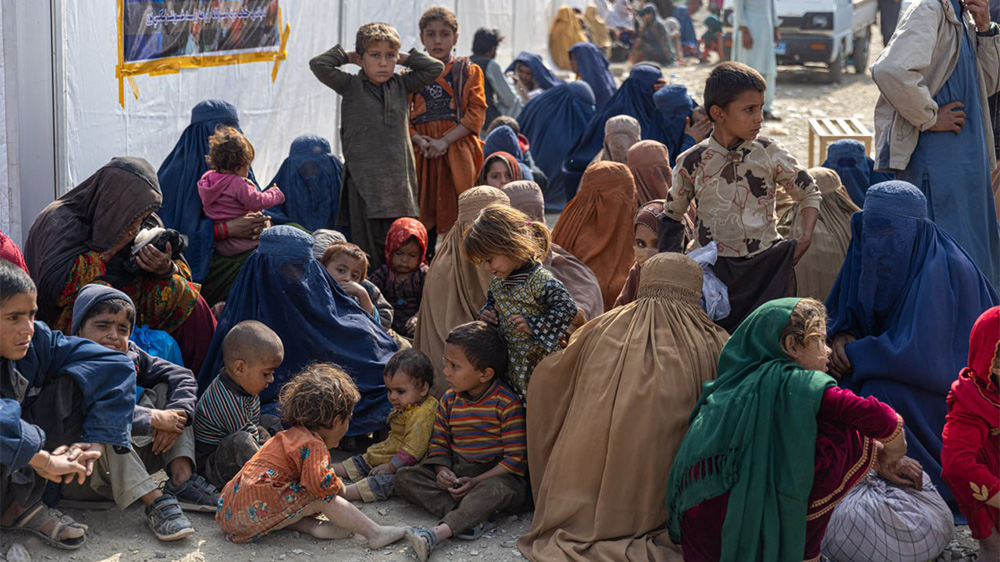

Why four decades of war, foreign aid and intervention have failed to build a stable economy
By Mohammad Bashar
Afghanistan is usually described as a country destroyed by decades of war. That is true, but it does not fully explain why poverty has remained so difficult to overcome. For more than forty years, Afghanistan has received enormous amounts of foreign money, military assistance and development support. Governments have been overthrown and rebuilt, roads and schools constructed, millions of children educated, and much of the country connected to modern communications and markets. Yet these changes never produced an economy strong enough to stand on its own. When the international military presence ended in 2021, much of the economic system built during the previous twenty years came under severe pressure. The deeper question, therefore, is why so much effort has produced so little lasting economic independence.
One useful way to understand this problem is through economist Paul Collier’s idea of “poverty traps”: conflict, dependence on natural resources, geographical disadvantages and weak or corrupt institutions. Afghanistan has experienced all four, and they reinforce one another. War destroys economic activity and institutions; weak institutions make corruption and armed competition easier; limited legal opportunities encourage informal and illicit markets; and geographical isolation raises the cost of legitimate trade. Foreign assistance can temporarily compensate for these weaknesses, but when it becomes a substitute for domestic economic capacity, it can also create dependency.
The roots of the problem go back long before the Taliban’s return in 2021. The Soviet invasion in 1979 transformed Afghanistan into a major battlefield of the Cold War. Villages were destroyed, agriculture disrupted, millions became refugees, and armed groups gained enormous political and economic power. When Soviet forces withdrew, the war did not end. The weapons, commanders and networks created during the conflict remained, and the civil war of the 1990s further weakened the country. Rival factions competed not only for political power but also for roads, border crossings, customs revenues and commercial routes. In an economy where education, farming and formal employment offered few secure opportunities, armed groups could become sources of income and protection. War therefore stopped being only something that destroyed the economy; it became part of the economy itself.
The Taliban’s rise in the 1990s was also connected to this environment. Years of fighting had left many Afghans exhausted by checkpoints, arbitrary taxation, kidnapping and violence. The Taliban promised order and security, gaining support in some areas even among people who did not necessarily share their ideology. Their emergence illustrated a larger weakness of the Afghan state: when formal institutions cannot provide security, justice or economic opportunity, other structures of power fill the gap.
The international intervention after September 11, 2001 brought major changes. It would be wrong to claim that those twenty years produced nothing positive. Millions of children received education, including a generation of Afghan girls; health services expanded; roads and telecommunications improved; universities grew; and a new urban middle class emerged. Afghanistan became considerably more connected to the outside world. These were real achievements. The fundamental weakness, however, was that much of this progress existed within an economy heavily dependent on international spending. Foreign forces, aid agencies, contractors and development projects created large numbers of jobs, while the government itself relied heavily on foreign financing, particularly for its security institutions. When international spending declined, the weaknesses of the economic model became impossible to ignore.
Afghanistan’s natural resources reveal another contradiction between potential wealth and actual wealth. The country possesses significant deposits of copper, iron, lithium, precious stones and other minerals, but resources underground do not automatically create prosperity. Mining requires electricity, roads, skilled workers, investment, secure contracts and institutions capable of ensuring that revenues benefit the public rather than powerful political or armed groups. Without those foundations, natural resources can become another source of competition and corruption.
The same problem appears in the illicit economy. Afghanistan’s opium economy has often been treated mainly as a criminal problem, but for many farmers it has also been an economic calculation. Where roads are poor, banks are absent, credit is limited and legal markets are unreliable, a crop with an established buyer can be more attractive than legal alternatives. This does not make the illicit economy beneficial; it shows how weak the formal economy is. Informal trade and smuggling survive because they are often better adapted to an environment of unreliable institutions, expensive transport and limited access to finance.
Geography adds another serious constraint. Afghanistan is landlocked and mountainous, making transportation expensive and leaving the country dependent on neighboring states for access to international markets. Pakistan has historically been one of its most important trade routes, while Iran and Central Asia provide alternative possibilities. Political tensions and weak infrastructure, however, have prevented Afghanistan from fully exploiting its strategic position between Central and South Asia. Geography itself does not condemn a country to poverty—Switzerland and Austria demonstrate otherwise—but geography combined with conflict, poor infrastructure and weak institutions can become a powerful economic disadvantage.
The deeper problem is the weakness of the state. Afghanistan has repeatedly had ministries, constitutions, armies and formal legal systems, but government authority has often been uneven across the country. Local leaders, tribal structures, religious authorities and commanders have frequently remained important centers of power. The Islamic Republic made substantial progress in building formal institutions after 2001, but it also suffered from corruption, patronage and political competition. It would be too simple to say that corruption alone caused its collapse. The larger problem was that political power often determined access to economic opportunities, contracts and public resources, making institutions less predictable and weakening public trust.
The return of the Taliban in 2021 has made this development problem even more serious. Their ideology and governing system are fundamentally at odds with many of the conditions required for modern economic development: broad access to education, equal participation, intellectual freedom, individual initiative, institutional openness and engagement with the outside world. Their exclusion of girls from secondary and higher education and restrictions on women’s employment are not merely social policies; they are direct attacks on Afghanistan’s human capital. A country that already lacks skilled workers cannot afford to remove millions of people from education and productive economic activity. More broadly, the Taliban’s emphasis on ideological conformity, political control and restrictions on civil society creates an environment hostile to innovation, investment and institutional development. They may have achieved political control over the country, but political control is not economic progress.
The problem is therefore not simply that the Taliban inherited a poor country. Their governing model risks reproducing the very conditions that keep Afghanistan poor. Development requires educated people, economic freedom, predictable institutions, political inclusion and international economic connections, while the Taliban have increasingly pursued restriction, exclusion and ideological control.
Humanitarian assistance can prevent greater suffering, but it cannot permanently substitute for a productive economy. If the Taliban continue sacrificing education, women’s participation and international integration for ideological control, Afghanistan will remain trapped not only by the destruction of its past but also by policies imposed on its future.
The international community also faces a difficult dilemma. Afghanistan still needs humanitarian assistance, and cutting it abruptly would punish ordinary people for decisions over which they have little control. The long-term goal should therefore be a transition toward an economy in which Afghans can earn their livelihoods through productive work and the state can finance basic services through domestic revenue.
The failure of foreign intervention is also more complicated than saying that foreigners simply “did not understand Afghanistan.” The Soviet Union tried to reshape the country through military force, while the United States and its allies attempted to build a modern state within an extremely fragmented political environment. Both interventions were very different in ideology and purpose, yet both produced governments heavily dependent on external support. Foreign assistance was not inherently the problem; the problem was that it often substituted for domestic institutional capacity rather than building enough of it to make the state self-sustaining.
Afghanistan is therefore caught in several poverty traps at once. Conflict destroyed productive capacity; natural resources and illicit markets created opportunities for powerful networks; geography raised the cost of legal trade; and weak institutions allowed corruption and patronage to become deeply rooted. The Taliban’s restrictions on education, employment and political participation now add another obstacle by weakening the country’s human capital and international connections.
Breaking this cycle will require more than another foreign project designed from outside. Afghanistan needs international assistance, investment and regional cooperation, but these should strengthen institutions rather than permanently replace them. It needs better trade routes, infrastructure, transparent resource management, functioning financial institutions and a business environment in which legal economic activity is worthwhile. Above all, it needs to invest in its people.
Afghanistan has resources, a strategic location and a large population capable of contributing to its economy. What it has lacked is a stable political and institutional framework capable of turning those advantages into broad prosperity.
The central problem is therefore not simply poverty or a shortage of resources. It is the political and economic system that has repeatedly prevented Afghans from turning resources, labor and foreign assistance into lasting development.
Afghanistan does not need to be saved again. It needs the conditions in which Afghans can build a country that does not have to be saved every few decades. The real challenge is to change the rules that have allowed war, dependency, weak institutions and poverty to reproduce for generations.

