

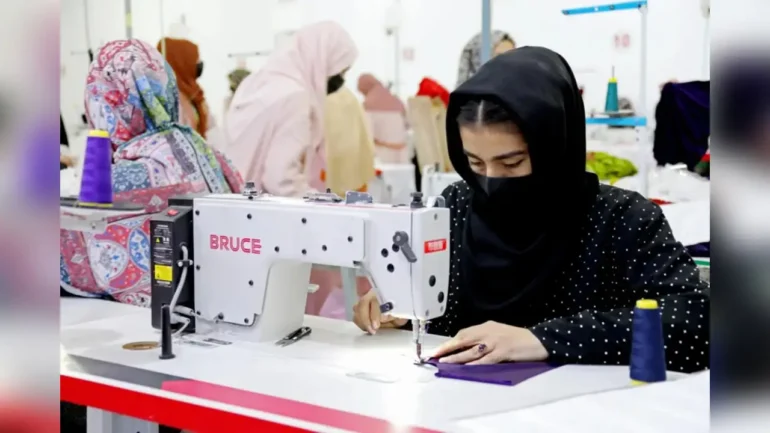

KABUL, AFGHANISTAN – The United Nations Development Programme (UNDP) and UN Women have launched a new fund aimed at supporting women entrepreneurs in Afghanistan, with an initial investment of about $1.7 million expected to benefit 1,500 women over the next year.
In a statement, the two UN agencies said the Afghanistan Women’s Fund for Resilient Businesses will provide Sharia-compliant financial services alongside business development support, including financial and digital literacy training, mentoring, business-plan development and assistance in accessing markets.
The agencies said they also aim to mobilize an additional $10 million to expand the initiative. The additional funding could provide financial and business support to another 10,000 women entrepreneurs and indirectly benefit around 70,000 people.
According to the statement, the fund is intended to address the significant financial barriers faced by women entrepreneurs in Afghanistan. Fewer than 7 percent of women in the country have a bank account or use mobile-money services, leaving many women-owned businesses dependent on personal savings, loans from family and friends, or the sale of personal assets to finance their operations and expansion.
Despite these barriers, the UN agencies said an increasing number of Afghan women are turning to entrepreneurship to generate income and support their families.
More than 10,000 women in Afghanistan now hold business licenses, according to the agencies, a figure they said is 10 times higher than five years ago. The Afghanistan Chamber of Commerce and Industry estimates that another 120,000 women are engaged in business activities without formal licenses.
Turhan Saleh, UNDP’s representative in Afghanistan, said the main challenge facing women entrepreneurs is not a lack of entrepreneurial spirit but limited access to finance, skills and networks needed to grow their businesses.
He said the new fund would provide Sharia-compliant financing without requiring collateral, practical business support and ongoing mentoring to help women strengthen their businesses, increase their resilience and establish more secure livelihoods for themselves and their families.
Susan Ferguson, UN Women’s representative in Afghanistan, said expanding women’s access to finance is critical to the growth of women-owned businesses.
She said Afghan women continue to find ways to establish businesses despite the barriers they face, adding that greater access to financial resources could help them turn their ideas and skills into stronger businesses, more employment opportunities and greater economic security for their families and communities.
The Taliban has imposed sweeping restrictions on women’s education, employment and participation in public life since returning to power in August 2021. These restrictions have significantly affected women’s access to formal employment and economic opportunities.
However, women-owned businesses have increasingly become an important source of income for women and their families. A UNDP policy brief published in 2025, based on a survey of 610 women-led micro, small and medium-sized enterprises, found that 80 percent of women-led enterprises surveyed relied on business revenue as their primary source of income.
The brief also said women’s employment stood at only 7 percent in 2024, while growing restrictions on mobility and access to jobs were making women-owned businesses one of the few viable sources of income and employment for many women.
The World Bank has likewise reported that restrictions on women’s economic participation continue to undermine Afghanistan’s human-capital development and economic growth. Its April 2025 Afghanistan Development Update said women who are working are often concentrated in informal, low-productivity jobs with unstable earnings, while restrictions on women’s participation in large parts of the formal economy continue to limit employment opportunities.
The World Bank’s data also show the scale of the gender gap in Afghanistan’s labor market: female labor-force participation was estimated at 5.1 percent in 2025, compared with 69.8 percent for men, while 92.9 percent of employed women were in vulnerable employment.
The new fund is therefore being launched as women entrepreneurs face both restricted access to formal employment and significant barriers to finance, while women-owned businesses continue to provide income for households and employment opportunities for other women.

