

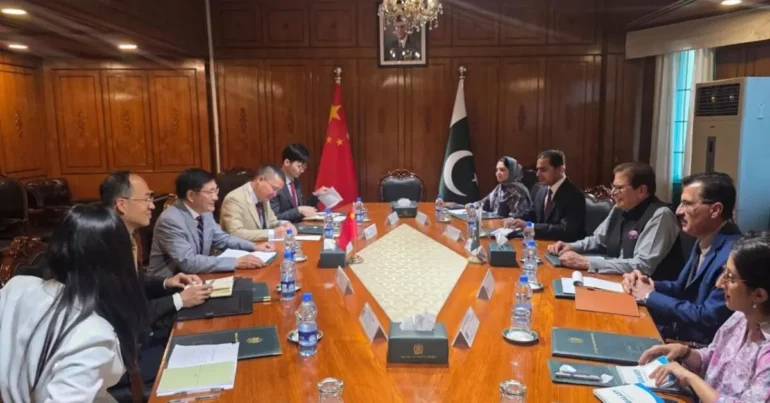

KABUL, AFGHANISTAN – Pakistan’s Special Representative for Afghanistan, Mohammad Sadiq, and China’s Special Envoy for Afghanistan, Yue Xiaoyong, have discussed security threats posed by the Tehrik-i-Taliban Pakistan (TTP) and the East Turkestan Islamic Movement (ETIM), which they said are operating from Afghan territory.
In a post on X, Mohammad Sadiq said the discussions took place on Monday (August 3) during Yue Xiaoyong’s visit to Islamabad.
“We exchanged views on the threats posed by TTP and ETIM operating from Afghan soil and agreed to strengthen bilateral coordination and deepen cooperation to counter terrorist threats and safeguard regional peace, security, and stability,” Sadiq wrote.
The discussions come amid a marked increase in militant attacks inside Pakistan, many claimed by or attributed to the TTP. Pakistani authorities have repeatedly accused the group of planning and launching cross-border strikes from safe havens in Afghanistan.
Reports by the United Nations Security Council’s sanctions monitoring team have also confirmed the presence of both the Tehrik-i-Taliban Pakistan (TTP) and the East Turkestan Islamic Movement (ETIM) in Afghanistan.
The Taliban however, have consistently denied these claims, insisting that Afghan territory is not used to threaten other countries. They argue that the TTP insurgency is a domestic matter for Pakistan and reject accusations of offering support to the group.
The ongoing disagreement has further strained bilateral ties, leading to periodic cross-border tensions. Pakistan has conducted air strikes inside Afghanistan targeting alleged militant hideouts, while both sides have also been involved in intermittent clashes along their shared border.
The impact of these incidents has also been reflected in civilian casualties. In its latest quarterly human rights report released on July 28, the United Nations Assistance Mission in Afghanistan (UNAMA) said it documented 399 civilian casualties during the reporting period, including 40 women and 112 children.UNAMA attributed all recorded cross-border civilian casualties to Pakistani security forces, noting that airstrikes and ground engagements were the primary causes of harm.
China has also expressed longstanding concerns about the East Turkestan Islamic Movement (ETIM), a militant group that Beijing accuses of promoting separatism and fueling instability in its Xinjiang region. Chinese authorities have alleged that ETIM members have used areas along Afghanistan’s northeastern border as transit routes and possible bases for activities directed against China.
Pakistan and China maintain close political, economic, and security ties and have increasingly coordinated their positions on Afghanistan since the Taliban returned to power in 2021. Both countries have repeatedly called for stronger measures against militant groups that they say pose threats beyond Afghanistan’s borders.

