

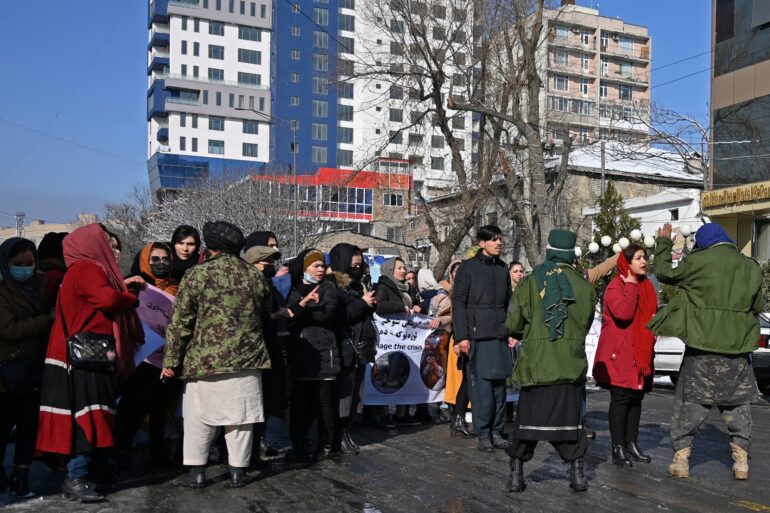

KABUL, AFGHANISTAN – The women of Afghanistan have been awarded the prestigious 2026 Chatham House Prize for their extraordinary courage and resilience in the face of systematic gender persecution under Taliban rule, the UK-based policy institute announced.
In a statement on Thursday, Chatham House said the award recognizes the determination of Afghan women and girls who have continued to resist an expanding range of restrictions on their rights and freedoms since the Taliban returned to power in August 2021.
“The women of Afghanistan have shown extraordinary courage and resilience in the face of systematic efforts to exclude them from education, work and public life,” said Bronwen Maddox, director and chief executive of Chatham House.
“Their courage embodies the determination of a much broader movement for women’s rights and challenges the rest of the world not to look away. This award recognises those efforts and the example they set in the face of extraordinary restrictions,” Maddox added.
Chietigj Bajpaee, a senior research fellow for South Asia at Chatham House, said Afghan women and girls had suffered more than any other community under renewed Taliban rule, losing access to education, employment and freedom of movement.
“Through awarding the Chatham House Prize to the women of Afghanistan, we aim to do our part in raising awareness of an issue that has tragically fallen off the radar of the international community,” Bajpaee said.
The prize will be presented at a special event at Chatham House later this year, along with a scroll signed by Britain’s King Charles, patron of the Royal Institute of International Affairs, according to the statement.
Launched in 2005, the Chatham House Prize has previously been awarded to Ukrainian President Volodymyr Zelenskyy, Médecins Sans Frontières and the Committee to Protect Journalists.
Chatham House, formally known as the Royal Institute of International Affairs, is a leading London-based policy institute that focuses on geopolitical challenges and international issues.
Since returning to power in August 2021, the Taliban has imposed sweeping restrictions on women and girls. Authorities have barred girls and women from secondary and higher education, restricted women’s access to most forms of employment and limited their ability to enter public spaces such as parks and gyms.
The Taliban has also imposed restrictions on women’s freedom of movement and other aspects of their participation in public life. UN experts, human rights organizations and activists have described the policies as systematic discrimination against women and girls, with some referring to them as “gender apartheid.”
Afghan women and girls inside and outside the country continue to protest and campaign for the restoration of their rights, urging the international community to pressure the Taliban to lift restrictions and respect their fundamental rights.

