

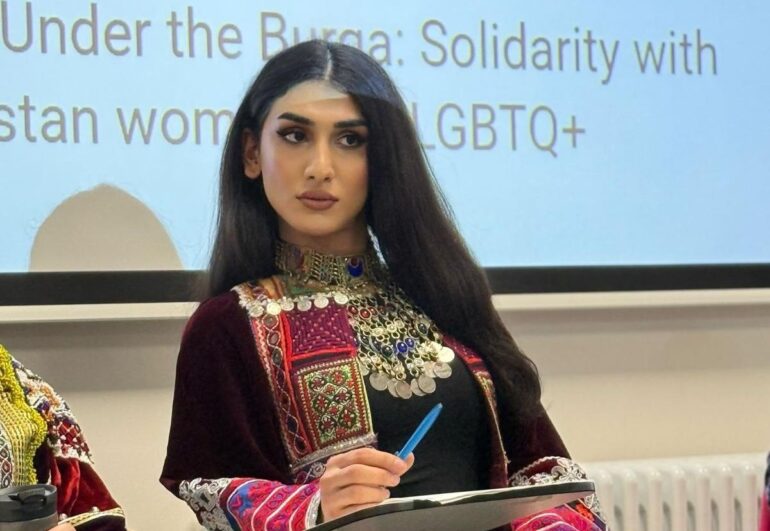

The day the Taliban entered Kabul, Sediqi was in the street. “I was walking when someone yelled, ‘The Taliban are here! They’ve taken Kabul!’” she says. “I turned and saw cars and motorcycles. The Taliban were driving through.” She asked a stranger for the scarf hanging over his shoulder, wrapped it around her face, and ran to a friend’s house, the nearest place she could hide.
For days afterward, as the city around her filled with people trying to reach the airport, she tried to find a way out. Eventually, with help from an organization that supports LGBTQIA+ people from Afghanistan, she made it across the border into Pakistan. From there, she traveled to Ireland with a small group from the same community, arriving about a month after the Taliban took Kabul.
She has now lived in Dublin for nearly five years. Though she initially avoided the city’s Afghan community and chose to stay hidden, she eventually found a small group of Afghans who accepted her and made her feel safe. But she still keeps her distance from others in the community who, she says, do not accept her.
Haya Sediqi is 23 years old, from Afghanistan, and now lives in Dublin. For her, home was never a place. It was a feeling, one she says she rarely found in Afghanistan and has only recently begun to find in Ireland.
“Wherever I feel happiness, peace, and my womanhood, that is home for me,” she says.
Sediqi grew up in a culture that, by her own account, had no space for people like her. “Trans people, especially trans women, have no recognized identity in Afghan society,” she says. Sediqi says her relationship with that culture is not one of rejection but of complicated love. “My spirit and my heart remain firmly tied to Afghanistan,” she says.
That tension between a culture that denies her existence and a heritage she refuses to abandon runs through everything she describes. She talks about wanting to preserve the positive parts of Afghan culture and pass them on to the next generation, even as she says she has no desire to ever return to the country.
For Sediqi, language has been one of the clearest markers of the exclusion she experienced in Afghanistan, but it has also been a source of unexpected freedom. Her mother tongue carries the weight of the trauma she experienced growing up, and speaking it still brings back that discomfort. “In my mother tongue, I never had a place. I had nothing to measure myself against,” she says. “I don’t even have the right to speak. I have no identity.”
English, by contrast, feels untouched by that history and gives her a language in which she does not carry the same fear. “When I speak in English, it’s as if I have an identity. My voice is heard,” she says. Sediqi is still learning English, so each word feels new and carries no history for her.
Farsi is different: every word in it is bound up with her past, and speaking it means explaining herself and reliving her whole life. It is not that she could not speak her native language, she explains, but that speaking it now means reliving old pain. “I was always erased or ignored,” she says of how it felt to use it.
Asked what she would tell her younger self, Sediqi doesn’t hesitate. “I would tell her to be patient, that a path to freedom would be found,” she says. “That the dark and difficult days would end. That she would no longer need to cry alone in the dark.” She adds a phrase she often returns to: “The lamp of the oppressor’s tyranny does not burn forever.”
That younger self, she says, was in crisis, isolated within her family and community and surrounded by people she describes as hostile. She was caught in a one-sided love for a country that never fully welcomed her. She loved Afghanistan and its culture, she explains, even though it never loved her back.
Her account reflects patterns documented by Rainbow Afghanistan, a Berlin-based nonprofit supporting LGBTQIA+ Afghans both inside the country and among refugees and asylum seekers.
Published in August 2026, the organization’s report No Exit draws on interviews with 30 LGBTQIA+ Afghans. It documents arbitrary arrests, custodial torture, sexual violence, forced marriage, and economic destitution.
Basira Paigham, Rainbow Afghanistan’s executive director, told the author about Setara, the pseudonym of a young trans woman whose case the organization documented. Paigham said Setara had been cut off from her family and forced into survival sex work, exposing her to daily abuse and threats from clients and Taliban forces. “When we talk about human rights, we are talking about keeping people like Setara alive, even if it’s for one more night,” Paigham says.
Sediqi’s own experiences differed from those documented in the report. Years ago in Kabul, walking home from school through the Khairkhana area, she was attacked by a group of five or six men who beat her badly. It was one of several instances of abuse she says she faced on the street and at school simply for who she was. For Sediqi, Paigham’s research isn’t abstract. It’s a harsher version of the life she left behind, and the reason she says leaving felt less like a choice than a necessity: her life was in danger in Afghanistan, she says, a danger that deepened after the Taliban’s return to power.
Leaving Afghanistan for Ireland didn’t bring instant relief for Sediqi. For weeks after her arrival in Ireland, she thought she was dreaming. “I thought it was a dream, an illusion,” she says. “I didn’t believe life was real. I thought it was a lie.” The fear lingered even though she was now in a safer place. She says she instinctively expected strangers to attack her.
What changed things, she says, was going to college. “The people of Ireland welcomed me with great kindness and respect,” she says. “That was when I felt safe, and life started to feel more real.” Being accepted by teachers and classmates brought both safety and genuine happiness. The trauma hasn’t disappeared entirely. “Sometimes when I’m walking on the street, I feel afraid for no reason,” she says. “I feel like someone might attack me. But overall, I carry on my life in peace and happiness.”
Even in Dublin, however, her loneliness persists. “Sometimes I feel like I only belong to myself,” she says. But she’s clear about what she owes herself: “I owe all of this happiness and freedom to myself, for having endured such difficult days in Afghanistan.”
For Sediqi, freedom has a precise meaning. “It means the simple feeling of being respected, of being treated as human,” she says.
She’s blunt about the risks trans women from Afghanistan face, both at home and in exile, including sexual violence and exploitation. She hopes society’s attitudes will change so “we can all live happily and safely, without seeing our differences as bad, but as beautiful.”
Looking ahead, Sediqi is studying fashion in Dublin, with hopes of building her own brand and eventually working with leading fashion houses. But her larger ambition is collective, not just personal. She wants to help other LGBTQIA+ Afghans, who continue to live in harsh and often life-threatening conditions, find a path to safety. “My biggest goal is to find a way for a group of people who are in my situation, who are trans, to come to Ireland or somewhere else and taste the sweet flavor of freedom,” Sediqi says. She calls her departure from Afghanistan a rebirth. “For me, freedom is a renaissance,” she says. “It means a life where I am my true self.”

