

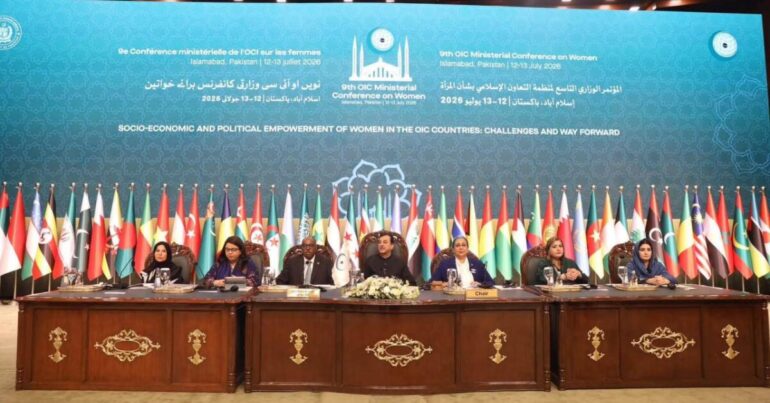

KABUL, AFGHANISTAN – Participants at a ministerial conference of the Organization of Islamic Cooperation (OIC) expressed deep concern over the Taliban’s continued restrictions on women’s and girls’ education and employment, saying the measures “tarnish the essence and image of Islam.”
In a declaration issued after the 9th OIC Ministerial Conference on Women, held in Islamabad on July 12-13, delegates said the restrictions are inconsistent with Islamic values that uphold the dignity, rights and advancement of women and girls.
The conference brought together delegates from the OIC’s 57 member states under the theme “Socio-Economic and Political Empowerment of Women in the OIC Countries: Challenges and the Way Forward.” No Taliban representatives were present, though Afghanistan’s tricolor flag was displayed among those of other countries
According to the declaration, participants expressed “deep disappointment and regret” over the continued suspension of secondary education for Afghan girls and restrictions on employment opportunities for women.
They called on the Taliban to lift restrictions on women’s and girls’ access to education and employment and to ensure their full, equal and meaningful participation in public life in accordance with Islamic principles.
Participants also urged member states to strengthen women’s participation in political, economic, educational, and social life, describing women’s empowerment as essential to sustainable development.
The conference launched the “Islamabad Initiative on Women’s Digital Inclusion,” a voluntary OIC platform to promote digital literacy, entrepreneurship, STEM education, artificial intelligence skills, cybersecurity awareness, and equitable access to digital technologies for women and girls across member states.
Taliban chief spokesperson Zabihullah Mujahid rejected the criticism, telling TOLOnews on Tuesday that women’s rights in Afghanistan are fully protected under Islamic Sharia. “The Islamic Emirate of Afghanistan [Taliban] has ensured all the rights of our sisters that are required under Sharia and considers itself fully committed to fulfilling these obligations. There should be no concern in this regard,” he said.
Since regaining power in 2021, the Taliban have barred girls from education beyond primary school, banned women from many public spaces, including parks, and removed them from most government positions and the judiciary. The measures have drawn criticism from the United Nations, rights groups, and several Muslim-majority countries.
The OIC, which represents Muslim-majority countries and is the second-largest organization after the United Nations, has repeatedly raised concerns about the Taliban’s human rights record in Afghanistan, particularly regarding women and girls. It has previously stated that the group’s “misogynist policies are against our religion.”
Other prominent Islamic voices have echoed this stance. The Muslim World League, the largest Islamic non-governmental organization, along with several Islamic countries, has described the Taliban’s edicts against women as un-Islamic and has urged the group to reconsider and reverse the bans.
The Taliban defends their policies, arguing they align with their strict interpretation of Islamic law and dismissing external criticism as interference in Afghanistan’s internal affairs.

