

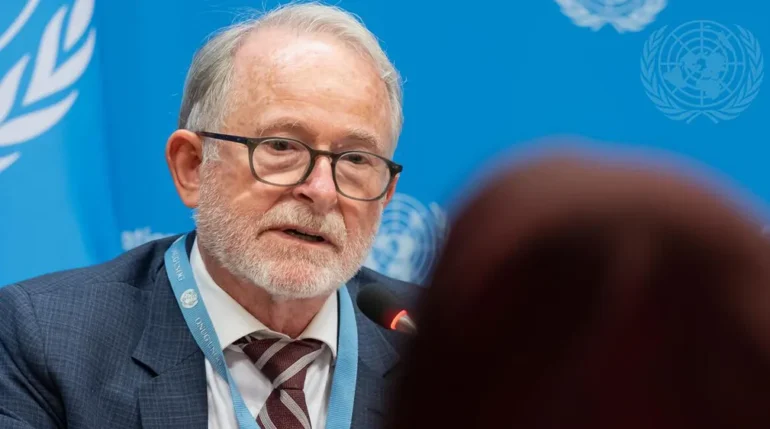

KABUL, AFGHANISTAN – UN Special Rapporteur on Human Rights in Afghanistan Richard Bennett has warned that Afghan migrants in Iran are among the most vulnerable groups affected by the ongoing conflict between Iran and the United States.
In a post on X on Saturday, July 25, Bennett condemned the renewed fighting between Iran and the United States, saying Afghan migrants are often overlooked despite facing the consequences of the conflict.
His remarks followed a joint statement by UN human rights experts condemning the resumption of hostilities between the United States and Iran, warning that renewed military strikes have caused civilian casualties, damaged critical infrastructure, disrupted essential services and maritime trade, and heightened the risk of a wider regional conflict.
The experts urged all parties to de-escalate, comply with international humanitarian law, protect civilians and civilian infrastructure, and return to negotiations, stressing that vulnerable groups, including refugees, women, children, minorities, and people living in poverty, are bearing the heaviest burden of the conflict.
He also referred to the continued executions of Afghan nationals in Iran, describing the situation as deeply concerning.
Separate data from the Iran Human Rights group shows that Iranian authorities have executed at least 370 people since the beginning of the year, including nine women and 11 Afghan nationals. Rights groups note that the true figure is probably higher, as not all executions are publicly reported and some prisoners’ identities remain undisclosed.
The renewed conflict has had severe humanitarian consequences for millions of Afghan migrants living in Iran. Earlier, on May 14, Jan Egeland, Secretary General of the Norwegian Refugee Council (NRC), warned that more than four million Afghans in Iran had become the “forgotten victims” of the war, as many lost jobs in construction and other informal sectors, while soaring inflation and rising food prices left families struggling to afford food, rent, and healthcare.
He said the NRC had responded by providing emergency cash assistance, psychosocial support, repairing war-damaged schools, and creating safe learning spaces for Afghan children. These concerns have since been echoed by UN Special Rapporteur Richard Bennett, who has warned that Afghan migrants remain among the most vulnerable and overlooked populations affected by the ongoing conflict.
The war by the United States and Israel has also claimed several Afghan migrant victims.
Earlier reports highlighted the deadly consequences of the conflict for Afghan migrants in Iran. local officials in Shahriar district, Tehran, confirmed that five members of an Afghan migrant family were killed during overnight US and Israeli strikes on residential areas in Shahedshahr. The victims included both parents and their three children, aged 3, 11, and 13.
six members of an Afghan family were also killed in US and Israeli attacks on Rey city in Tehran.
Prior to that, it was reported that an Afghan citizen named “Kowsar Adeli” was killed in US and Israeli attacks on the “Kheirabad Varamin” area.
The current conflict between Iran and the United States and Israel intensified after months of escalating tensions, including exchanges of missile and drone attacks, strikes on military facilities, and growing regional instability. In late February, hostilities expanded into a broader military confrontation, causing civilian casualties, displacement, and damage to critical infrastructure across Iran.
Efforts to end the fighting briefly gained momentum with a 14-point Memorandum of Understanding reached during negotiations in Islamabad, but the agreement collapsed after renewed military strikes and retaliatory attacks on July 12–13. The breakdown of the ceasefire prompted the United Nations and human rights experts to urge all parties to return to negotiations and protect civilians under international humanitarian law.

