

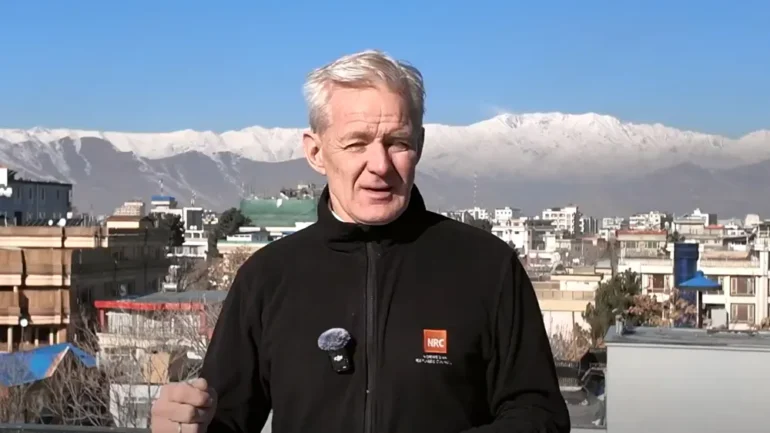

KABUL, AFGHANISTAN – Jan Egeland, Secretary General of the Norwegian Refugee Council, says that more than four million Afghan migrants are the overlooked and forgotten victims of the war by the United States and Israel against Iran.
Writing on X today (Wednesday, May 13), he said that with the outbreak of war in Iran, many Afghan migrants lost their jobs in the construction sector and other informal work.
Egeland added that now, as incomes collapse and inflation rises, these migrants can no longer afford to provide food for their families or pay rent.
He added that food prices have almost doubled since last year, forcing many people to cut back on meals, postpone medical care, and take on debt while continuing to live with the trauma and uncertainty caused by war and displacement.
Egeland said that the Norwegian Refugee Council has provided emergency cash assistance to thousands of migrant families in Iran so they can purchase essential goods and food.
He added that they have also provided psychosocial support services for children, parents, and teachers, repaired schools damaged by war, and created safe spaces so children can continue their education.
The Secretary General of the Norwegian Refugee Council said that while needs are growing much deeper as the crisis worsens, the organization currently has funding to assist only one thousand more families.
He stressed that unless additional funding is secured, the organization’s emergency assistance will face a complete funding shortfall within the next month, leaving many vulnerable people without any support.
Many Afghan migrants in Iran work as daily wage laborers in construction and other physically demanding jobs, but with the outbreak of war and the halt of construction work and other businesses, Afghan migrants are facing widespread economic hardship.
The war by the United States and Israel has also claimed several Afghan migrant victims.
Furthermore, earlier reports highlighted the deadly consequences of the conflict for Afghan migrants in Iran. About one month ago, local officials in Shahriar district, Tehran, confirmed that five members of an Afghan migrant family were killed during overnight US and Israeli strikes on residential areas in Shahedshahr. The victims included both parents and their three children, aged 3, 11, and 13.
six members of an Afghan family were also killed in US and Israeli attacks on Rey city in Tehran.
Prior to that, it was reported that an Afghan citizen named “Kowsar Adeli” was killed in US and Israeli attacks on the “Kheirabad Varamin” area.
More than four million Afghan migrants are present in Iran, and the intensification of the war and disruptions in internet and communications have worried their families in Afghanistan.
The current war between Iran, the United States, and Israel is one of the most serious escalations in the Middle East in recent years. The conflict intensified in February 2026 after U.S. and Israeli forces launched large-scale strikes targeting Iran’s nuclear facilities, military infrastructure, and key strategic sites. These attacks followed years of tension over Iran’s nuclear program and regional influence, as well as the collapse of diplomatic efforts to revive nuclear agreements.
Since then, the conflict has expanded rapidly, with Iran retaliating through missile and drone attacks not only on Israel but also on U.S. bases and several countries in the region. Major cities, including Tehran and Tel Aviv, have faced repeated strikes, and civilian areas have increasingly been affected. The war has also drawn in regional actors such as Lebanon and Gulf states, raising fears of a broader regional conflict.
The growing humanitarian crisis has intensified calls for the international community to increase support for displaced Afghan families in Iran, as aid agencies warn that without urgent financial assistance, thousands more could face hunger, homelessness, and the loss of access to essential services.

