

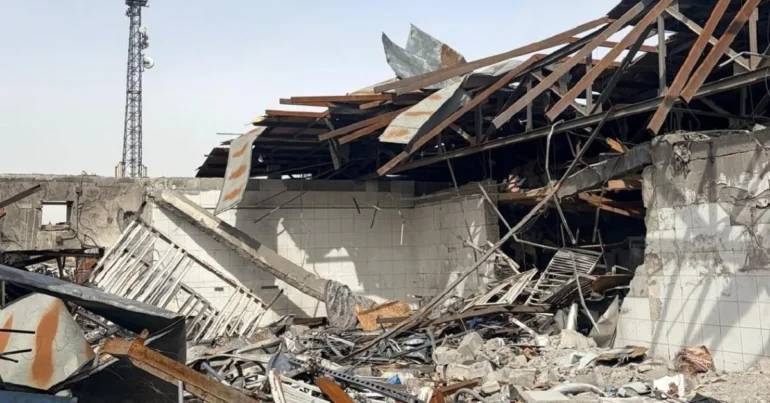

KABUL, AFGHANISTAN – Amnesty International has called for Pakistan’s airstrike on Kabul’s Omid Drug Rehabilitation Center to be investigated as a possible war crime, saying its four-month investigation found no evidence to support Pakistan’s claim that the medical facility was being used for military purposes.
In a report released on Tuesday, the rights organization said it found no evidence that the Omid Drug Rehabilitation Center had been used to store weapons, ammunition, or serve any other military function at the time of the attack.
Amnesty International said the strike violated the special protections afforded to medical facilities under international humanitarian law and warned that the absence of a credible investigation risks reinforcing impunity for violations committed during the conflict.
The Omid Drug Rehabilitation Center in Kabul was bombed by the Pakistani military on March 16, 2026. Amnesty International said at least 269 civilians were killed in the attack.
According to Amnesty International, the airstrikes took place at around 9:00 p.m., shortly after worshippers had finished Ramadan evening Tarawih prayers. Witnesses interviewed by the organization said that more than 1,000 patients were staying at the Omid Drug Rehabilitation Center on the night of the attack.
The organization said that under international humanitarian law, attacking forces are required to take all feasible steps to verify that a target is a legitimate military objective and must refrain from launching an attack if there is doubt about its military nature.
Amnesty International also noted that even if a medical facility is suspected of being used for military purposes, an attack is only lawful after an effective warning has been issued and disregarded. Its investigation found no evidence that any warning was given before the strike, while the timing of the attack during evening prayers increased the presence of civilians and left them with no meaningful opportunity to evacuate.
Following the strike, Pakistan’s Information Minister Attaullah Tarar said the military had targeted “technical support infrastructure and ammunition storage facilities” at two locations in Kabul, including the Omid center. He claimed that secondary explosions at the site indicated the presence of large ammunition depots.
Amnesty International said its investigation analyzed more than 60 photographs and videos, over 30 satellite images, and footage recorded before the attack. It also conducted 11 interviews with current and former employees of the Omid center, staff at the neighboring Ibn-e- Sina Hospital, emergency responders, and relatives of victims.
According to the organization, the investigation found no evidence supporting Pakistan’s claim that the rehabilitation center was being used to store weapons or ammunition or for any other military purpose.
Isabelle Lassee, Amnesty International’s Acting Regional Director for South Asia, said the attack represented a serious violation of international humanitarian law and could amount to a war crime.
“The attack on the Omid Centre constitutes a serious violation of international humanitarian law – possibly amounting to a war crime. Given the widely available information that the site had been used as a medical facility for more than a decade, this reflects a major failure in military planning by Pakistan that led to a significant loss of civilian life,” she said.
She urged the Pakistani government to conduct a prompt, independent, impartial, transparent, and effective investigation into the strike and, where sufficient evidence exists, prosecute those responsible, including military commanders under the principle of command responsibility.
“All parties to the conflict must respect international humanitarian law and take all feasible precautions to protect civilians and civilian objects, with particular care afforded to medical facilities and other specially protected sites. Failure to investigate serious violations, such as the attack on the Omid Centre, shows an alarming disregard for international law and risks entrenching impunity, leading to further unlawful operations and loss of civilian life,” said Isabelle Lassee.
Pakistan’s air campaign against Afghanistan began after border clashes with the Taliban escalated in October 2025. According to the United Nations Assistance Mission in Afghanistan (UNAMA), more than 750 civilian casualties, including 372 deaths and 392 injuries, have been documented in Pakistani airstrikes since then.
The latest deadly strike took place last month in Samkani district of Paktia province, where UNAMA reported that 28 civilians were killed and 49 others injured.
The Omid Drug Rehabilitation Center was one of Afghanistan’s largest public facilities dedicated to treating people with drug addiction. Located in Kabul, it was established in 2016 on the site of a former NATO base and initially operated as a vocational training center for people undergoing treatment for substance dependence. Following the Taliban’s return to power in 2021, the facility was expanded into a 2,000-bed drug treatment and rehabilitation center, providing inpatient medical care, rehabilitation services, and counseling for people with substance use disorders.
The center had become one of the country’s largest addiction treatment facilities and was widely recognized as a civilian medical institution. According to Amnesty International, its investigation found no evidence that the facility had been used for military purposes at the time of the Pakistani airstrike.

