


KABUL, AFGHANISTAN – The United Nations Office for the Coordination of Humanitarian Affairs (OCHA) has announced that Iceland has contributed 50 million Icelandic krona, equivalent to US$402,000, to the Afghanistan Humanitarian Fund.
OCHA thanked Iceland for its contribution and said that the funding will enable humanitarian partners to provide urgent assistance to families affected by crises across Afghanistan.
Humanitarian operations in Afghanistan are facing a funding shortfall.
According to OCHA, only 16 percent of the funding requested for humanitarian assistance to people in need in Afghanistan in 2026 has been secured so far.
The organization has requested US$1.72 billion to assist people in need in Afghanistan this year, but only US$269 million has been received to date.
Meanwhile, OCHA’s latest humanitarian update warns that Afghanistan continues to face worsening humanitarian challenges due to escalating cross-border hostilities with Pakistan, severe climate-related shocks, flooding, and chronic funding shortages.
Between January and March 2026, violence along the Afghanistan-Pakistan border reportedly caused hundreds of civilian casualties, displaced more than 100,000 people, and damaged homes, health facilities, and schools in several eastern provinces. The insecurity also disrupted humanitarian access, leaving thousands of vulnerable people without assistance for weeks.
According to the latest annual report of the Afghanistan Humanitarian Fund (AHF), an estimated 22.9 million people required humanitarian assistance, reflecting the cumulative impact of prolonged conflict, economic decline, climate shocks, and widespread poverty.
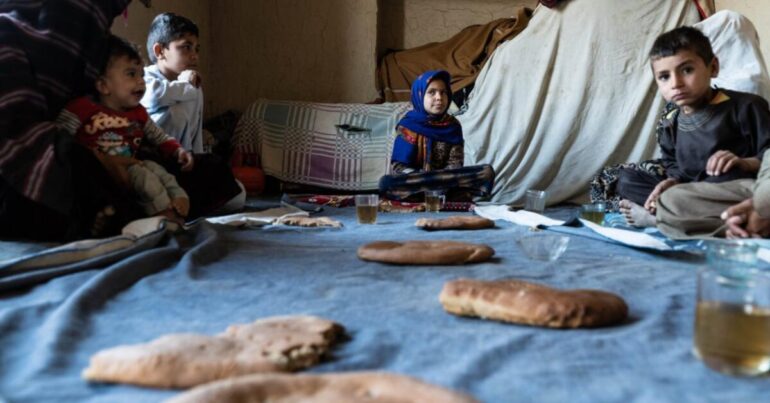
In particular, food insecurity remained a critical concern, with 14.8 million people experiencing acute hunger, while 7.8 million women and children required urgent nutritional support. These conditions were further exacerbated by recurring drought linked to La Niña, water scarcity, harsh winters, and flooding, all of which deepened vulnerabilities across both rural and urban communities.
At the same time, Afghanistan faced increasing population pressures due to large-scale returns from neighboring countries, especially Iran and Pakistan. As a result, already fragile systems were placed under additional strain, particularly in border regions and areas of return.
Against this backdrop, humanitarian agencies have emphasized the urgent need for additional international support. Aid organizations warn that without increased funding, their ability to respond to growing humanitarian needs—including emergency relief, healthcare, food assistance, and shelter—will remain severely constrained, putting millions of vulnerable Afghans at greater risk.
Consequently, difficult decisions will need to be made regarding resource allocation, with a focus on the most urgent and life-saving activities. In conclusion, while the Afghanistan Humanitarian Fund continues to play a critical role in delivering timely and flexible assistance, sustained international support will be essential to prevent further deterioration of the humanitarian situation and to ensure that millions of vulnerable people are not left without aid.

