

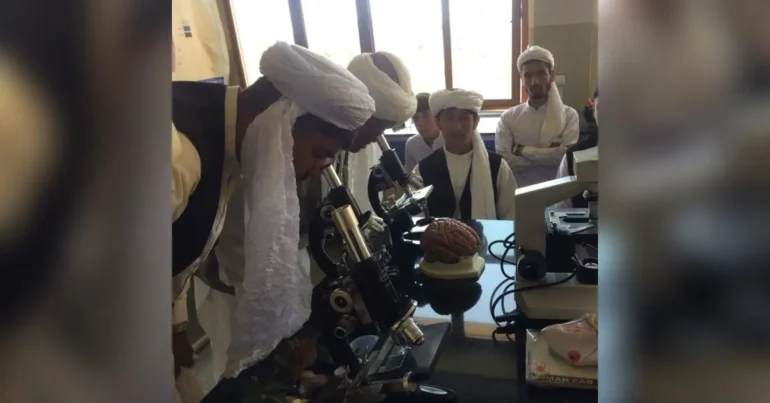

KABUL, AFGHANISTAN – A senior Taliban education official has claimed that Afghanistan now offers the best environment for education and progress in more than four decades, despite the group’s continued ban on secondary and higher education for girls.
Abdul Khaliq Sadiq, the Taliban’s Deputy Minister for Quality Assurance at the Ministry of Education, made the remarks during a ceremony honoring top performers in Afghanistan’s 1405 university entrance examination (Kankor).
He said the Taliban had created suitable conditions for “life, education, and development” by establishing nationwide security, adding that the country now enjoys the best opportunities for learning and advancement in over 40 years.
The Taliban have barred girls from attending school beyond the sixth grade for nearly five years and have also prohibited women from enrolling in universities and medical institutes. Human rights groups and UN experts have described the measures as amounting to “gender apartheid.”
According to the United Nations, the restrictions have deprived more than 2.5 million girls in Afghanistan of their right to education.
At the same time, the Taliban have expanded the construction and establishment of religious and jihadist seminaries across the country. The group is also seeking to establish a large jihadist seminary in the center of every province.
Last year, UNICEF and UNESCO said in a joint report on Afghanistan’s education system that significant changes to the primary school curriculum were being planned.
According to the report, under the revised curriculum, Islamic studies would account for nearly half of weekly teaching hours, increasing the amount of time devoted to religious instruction.
In a recently published joint report, UNICEF and UNESCO described Afghanistan’s learning crisis as alarming, noting that more than 90 percent of 10-year-old children are unable to read and understand a simple text.
The UN agencies stressed that education is a symbol of hope and stability for Afghanistan’s children, but this hope is rapidly diminishing. They called on the Taliban to lift restrictions on girls’ and women’s education at the secondary and higher levels, and urged the international community to increase investment in primary education and literacy programs.
UN agencies, international rights groups, and education advocates warn that these policies risk leaving an entire generation without basic literacy, essential skills, and future opportunities.

