

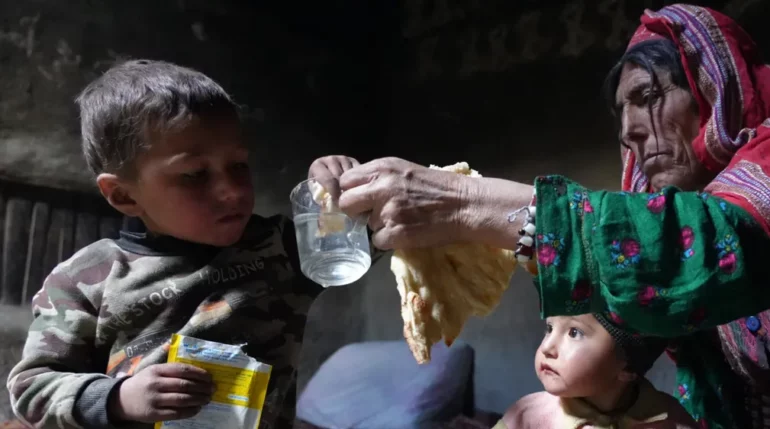

Food insecurity in Afghanistan is expected to worsen significantly, with 17.4 million people projected to face acute food insecurity during the upcoming winter, according to the latest report by the Integrated Food Security Phase Classification (IPC) released by the United Nations.
The report warns that food insecurity is likely to deteriorate during the four-month period from November 2025 to March 2026, which coincides with the winter lean season, when food availability and access typically decline. The number of people facing acute food insecurity is expected to rise from 13.8 million to 17.4 million during this period.
According to the IPC analysis published on Tuesday (December 16), during the current period (September–October 2025), around 2.9 million people were classified in Phase 4 (Emergency), while 10.9 million others were in Phase 3 (Crisis).
Out of 47 analysed areas — including 34 rural provinces and 13 major urban centres — 43 areas were classified in Phase 3. Only rural Kabul, Khost province, Khost city and Paktia were classified in Phase 2 (Stressed).
The UN noted that extremely limited food assistance coverage has been a key driver of worsening food insecurity, with humanitarian aid reaching only 2.7 percent of the population between September and October 2025.
The situation is being further aggravated by a weak and contracting economy, alongside the return of large numbers of migrants. The report highlights that more than 2.5 million people returned from neighbouring countries in 2025 alone, placing additional pressure on local resources, services and livelihood opportunities.
The IPC projects that approximately 17.4 million people — 36 percent of the population — will face Phase 3 or worse food insecurity during the first projection period. According to the Food and Agriculture Organization, 4.7 million people are expected to fall into Phase 4 (Emergency).
Provinces expected to experience the most severe conditions — classified in Phase 4 — include Badakhshan, Ghor, Faryab, Jawzjan, Samangan, Bamyan and Daikundi.
The report also notes limited employment opportunities and restricted access to resources for returnees and vulnerable populations, particularly in Herat, Kabul, Kandahar, Kunduz, Nangarhar and Paktika.
Humanitarian food security assistance is expected to remain far below needs, with aid projected to reach only around one million people — about 2 percent of the population — during this period, compared to 5.6 million people during the same period in 2024.
The UN warned that without sustained humanitarian assistance and strengthened livelihood support, millions of Afghans risk slipping deeper into crisis, potentially reversing the modest gains achieved in recent years.
A seasonal improvement is expected during the second projection period (April–September 2026), coinciding with the harvest season. The number of people facing Phase 3 or worse food insecurity is projected to decline to approximately 13.8 million — 28 percent of the population.
Gendered Food Insecurity
The IPC report stresses that food insecurity in Afghanistan remains highly gendered, disproportionately affecting women, girls and female-headed households.
Ongoing restrictions on women’s mobility, employment and participation in public life have significantly reduced household incomes, pushing many women toward informal and insecure livelihood options.
Female-headed households report the highest levels of food insecurity, with 63 percent identifying food as their most urgent unmet need.
Negative coping strategies — including early marriage, child labour and school dropout — are more prevalent among female-headed households, the report notes.
Funding cuts have further worsened conditions. Only 25 percent of female-headed households received assistance in the past two months, down from 43 percent in 2024.
The UN added that budget reductions have intensified operational constraints, limiting access to women and girls. Nearly 40 percent of humanitarian actors report being unable to cover costs related to employing female staff, including ongoing male guardian requirements and restrictive local directives.

