

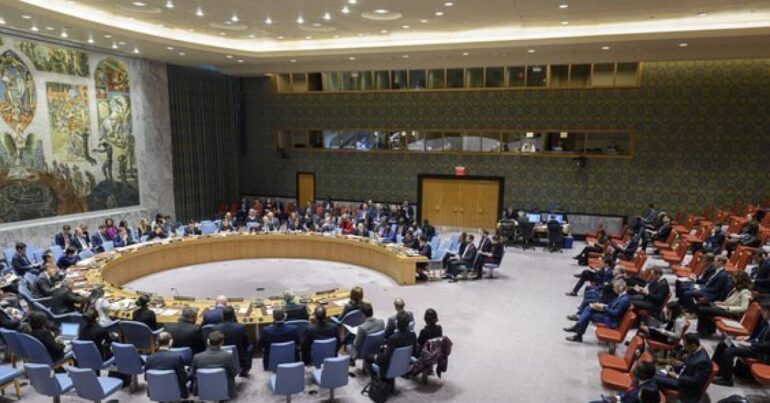

KABUL, AFGHANISTAN – Several members of the UN Security Council on Wednesday voiced renewed concern over the presence of multiple terrorist groups in Afghanistan under Taliban rule, warning that the country has once again become a safe haven for militants.
The concerns were raised during a council meeting on Afghanistan, where Georgette Gagnon, the UN deputy special representative for Afghanistan and acting head of the UN mission in Afghanistan (UNAMA), briefed council members on the overall situation in the country.
Gagnon said there has been no progress on several issues of concern to Afghanistan and the international community, including the continued presence of terrorist groups that threaten Afghanistan, the region and international peace and security.
Speaking at the meeting, Pakistan’s UN envoy Asim Iftikhar Ahmad said Afghanistan has once again become a base for numerous terrorist organizations that operate with impunity from its territory.
“Terrorism has been at the core of Afghanistan’s problems,” he told the council. “This finds its roots in the deep nexus between the Taliban and terrorist groups such as the TTP, BLA and its Majeed Brigade, ISIL-K, ETIM, and their affiliates that are operating with impunity on Afghan soil.”
Ahmad said Pakistan is among the countries most directly affected by terrorism emanating from Afghanistan, adding that more than 4,700 Pakistanis has been killed in terrorist attacks over the past three years.
“We expected that the Taliban would take concrete and verifiable actions against those terrorist groups,” Ahmad added. “Regrettably, they failed to act in complete disregard for the legitimate security concerns of Pakistan and other countries.”
The Pakistani envoy also raised concerns over advanced weapons and military equipment, including drones, as well as arms and ammunition left behind by international forces following their withdrawal from Afghanistan.
Russia’s UN envoy, Vassily Nebenzia, said Moscow also remains concerned about the continued presence of groups including ISIS-K and the Eastern Turkistan Islamic Movement (ETIM). “These groups continue to retain their capabilities, replenishing their ranks through recruiting new members and receiving illicit financial support for their activities,” he said.
The Russian envoy noted that ISIS-K tended to exploit every opportunity to destabilize the situation both inside Afghanistan and across the wider region, and that it remained difficult to assess how extensively militants are making use of weapons abandoned by NATO forces.
China’s representative Sun Lei described terrorism as the common enemy of mankind and said all countries have an obligation to combat groups including ISIS-K, al Qaeda, the East Turkistan Islamic Movement and the Pakistani Taliban (TTP) without any ambiguity.
The Chinese envoy called on the Taliban to eliminate terrorist groups operating within Afghanistan and to address the concerns of the international community through concrete action.
In his quarterly report submitted to the council on September 9, UN Secretary-General Antonio Guterres also highlighted the persistent threat from terrorist groups, particularly ISIS-K. The report cited recent claims of responsibility by the group, including an attack on a Taliban checkpoint in Waygal district of Nuristan province on June 30 that injured several Taliban security personnel, and the killing of a Taliban official near Faizabad, the capital of Badakhshan province, on July 29.
UN assessments have previously identified ISIS-K as the most significant terrorist threat emanating from Afghanistan. A UN monitoring report said the group retained significant operational and combat capabilities despite pressure from Taliban security operations and regional states.

