

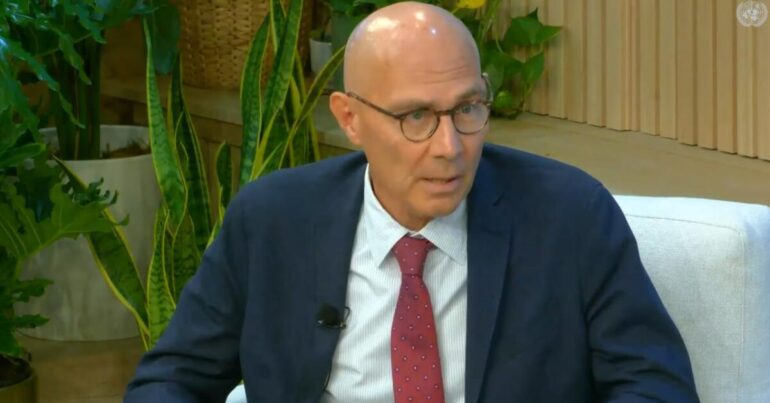

KABUL, AFGHANISTAN – Speakers at two United Nations-hosted meetings in New York have called for women’s rights and meaningful political participation to be placed at the centre of international engagement with Afghanistan, warning that the Taliban’s restrictions on women have become institutionalized and that excluding women from political processes risks undermining efforts to shape the country’s future.
UN High Commissioner for Human Rights Volker Türk said the Taliban were clearly violating international human rights obligations and had established a system of “gender apartheid” and domination over women.
Speaking on Monday at a UN Meeting on the situation of women in Afghanistan, Türk said the Taliban had issued more than 200 decrees and directives that had institutionalized a system in which the repression and subjugation of women had become normalized.
Türk said he used the term “gender apartheid” to describe the situation because it was important to accurately reflect what was happening to people in Afghanistan. He also said there had not been enough attention to the country’s human rights situation and its impact on women and girls.
The UN rights chief called for human rights, particularly the rights of women and girls, to be placed at the centre of international engagement with the Taliban. He said such engagement should not be limited to issues such as the return of migrants, humanitarian assistance or the normalization of relations.
Türk said that supporting gender equality must go beyond words and be reflected in concrete action, describing it as deeply troubling that, in the 21st century, a country could impose such restrictions without facing accountability.
He also warned that continued violations of women’s rights in Afghanistan could set a precedent for other countries to attempt to establish similar systems of gender apartheid.
Nasir Ahmad Faieq, Afghanistan’s representative to the United Nations, meanwhile, said women must have direct and meaningful participation in shaping any political process concerning the country’s future.
Speaking at a separate UN-hosted meeting titled “Women, Peace, Justice and National Reconciliation in Afghanistan,” held on the sidelines of the 81st session of the UN General Assembly, Faieq said women’s participation should not be reduced to symbolic representation or parallel consultations outside the main political process.
He said the international community should change the way it speaks about Afghan women, arguing that they should not be viewed solely as victims in need of protection, but as political actors and leaders who must have a direct role in shaping Afghanistan’s future.
Faieq said women’s participation at the decision-making table was essential if Afghanistan was to move towards a legitimate and sustainable political settlement. He said the country’s challenges went beyond humanitarian concerns or the reopening of girls’ schools and required a comprehensive approach.
According to Faieq, existing international legal and political frameworks—including UN Security Council Resolution 1325, the Women, Peace and Security agenda and the Convention on the Elimination of All Forms of Discrimination Against Women (CEDAW)—already provide important commitments to support women. He said the central problem was not a lack of commitments, but the gap between those commitments and their implementation.
Faieq also said the Taliban were only “one stakeholder” in Afghanistan and could not alone represent the country’s diverse population and aspirations. He argued that any political arrangement imposed through force, exclusion or intimidation would not be sustainable and called on the international community to help create a political space in which Afghans, particularly women, could participate in determining the country’s future.
Mitra Mehran, a women’s and human rights activist, called on countries to support recognition of gender apartheid in Afghanistan as a crime against humanity under international law. She said 14 countries had so far supported such recognition and urged others to join the effort. Mehran also emphasized the political agency of Afghan women and criticized the lack of transparency in the international community’s approach to Afghanistan, including the exclusion of women and civil society representatives from political processes such as the Doha process.
Gaisu Yari, a women’s rights activist and former commissioner of Afghanistan’s Independent Administrative Reform and Civil Service Commission, similarly criticized international engagement and normalization of relations with the Taliban. She said Afghan women and girls had continued to resist restrictions through underground education, protests, documentation of rights violations, artistic work and other forms of civic action, while some international actors’ engagement had, in her view, encouraged the Taliban to further consolidate their restrictions on women.
Yari also highlighted a series of restrictions imposed on women and girls since the Taliban returned to power, arguing that the measures amounted to an institutionalized system of gender-based repression. She called for greater space for women and girls inside Afghanistan to speak for themselves and urged the international community not to allow their exclusion to become normalized.
Five years after the Taliban returned to power, Afghanistan continues to face profound political, humanitarian, economic, social and human rights challenges. The speakers at the UN meetings emphasized that the future of the country cannot be addressed solely through humanitarian assistance or diplomatic engagement, and that the meaningful participation and rights of Afghan women remain central to any discussion of a sustainable political future.

