

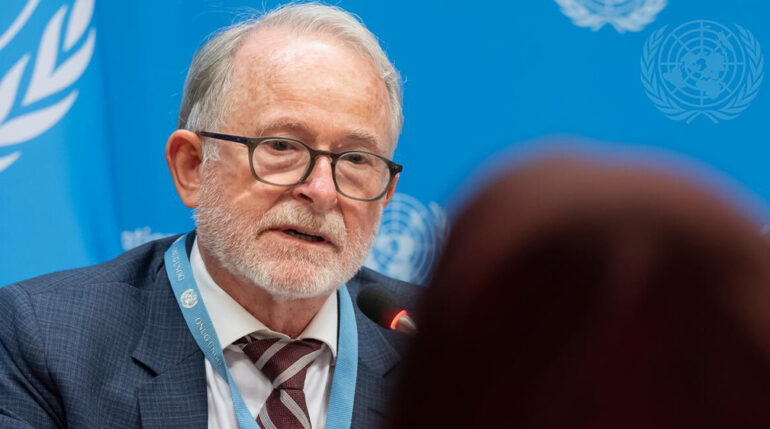

KABUL, AFGHANISTAN – Richard Bennett, the United Nations Special Rapporteur on the situation of human rights in Afghanistan, has warned that children and young people are bearing the consequences of a deepening human rights, humanitarian and economic crisis under the Taliban, with restrictions on education, widespread hunger, child labour, forced and child marriage, violence and the erosion of child-protection mechanisms threatening the future of an entire generation.
In his latest report, covering developments from November 2025 to August 2026, Bennett said Taliban policies and decrees had affected virtually every aspect of life in Afghanistan and had particularly severe consequences for women, girls, children and young people.
He said the Taliban had created an environment characterized by fear, exclusion and ideological conformity, while dismantling important legal and institutional protections that had previously existed for children.
The report highlights the scale of the education crisis facing Afghan girls. According to UNICEF estimates cited by Bennett, around 3.8 million girls between the ages of 7 and 18 were out of school in 2024, including more than 2.6 million adolescent girls. The Taliban’s ban on secondary education for girls has directly affected at least one million girls over the past five years, while the number could exceed two million by 2030 if the current policies continue.
Despite the restrictions, Afghan women and girls have continued to seek alternative ways to study. The report says more than 100 organizations have formed networks providing online, community-based and cross-border educational opportunities. However, Bennett notes that these alternatives remain inaccessible to many girls, particularly those in rural areas and from low-income families, because they depend on access to the internet, digital devices and suitable learning environments.
At the same time, the report points to a major expansion of religious education. The number of registered, organized or Taliban-established religious institutions increased from about 5,000 before 2021 to more than 23,000 by September 2025. Bennett warns that, alongside the restrictions on formal education, this development could have long-term consequences for Afghanistan’s social fabric.
The humanitarian situation is also placing millions of children at risk. According to the Integrated Food Security Phase Classification estimates cited in the report, around 9 million children in Afghanistan — approximately one in three children — are facing acute hunger. An estimated 3.7 million children under the age of five are suffering from acute malnutrition.
Bennett said the food crisis directly threatens children’s rights to food, health and development. Families and children consulted for the report described reductions in both the quantity and quality of food available to them. Some children reportedly attend school hungry and struggle to concentrate because they have not received adequate nutrition.
The report also raises serious concerns about the collapse of Afghanistan’s child-protection system. The 2019 Law on the Protection of Child Rights, which defined a child as anyone under 18, has been suspended. Other laws, including legislation governing juvenile justice, juvenile rehabilitation centres and the prevention of harassment of women and children, have also been suspended. Bennett says Afghanistan is consequently left without a clear legal definition of a child.
The report highlights several major risks facing children in Afghanistan, including the closure or disruption of child-protection centres and the replacement of specialized personnel with people lacking relevant expertise. Economic hardship and food insecurity are pushing more children, particularly boys, into labour in agriculture, brick-making, mining and domestic work, while girls’ work is likely underreported because much of it is unpaid and takes place at home.
Bennett also raises concerns about increasing child and forced marriages, with some girls reportedly married to much older men or given in marriage to help families repay debts. Children and young people, especially girls, are also experiencing serious mental-health problems linked to exclusion from education, restrictions on freedom, poverty and uncertainty about the future, with suicide attempts reportedly occurring but likely underreported.
The report further documents children’s exposure to sexual violence, rape, exploitation and corporal punishment in schools and religious institutions. Finally, the dismantling of the specialized juvenile justice system has left children in conflict with the law more vulnerable, with some detained alongside adults and subjected to corporal punishment for offences such as begging, dress-code violations, theft, drug-related offences and alleged extramarital relationships.
Armed conflict and cross-border violence continue to take a toll on children. According to the UN Secretary-General’s report cited by Bennett, 1,070 grave violations against children were documented in Afghanistan in 2025. During the same year, 103 children were reportedly killed or injured in cross-border bombardments and airstrikes by Pakistani forces.
UNAMA recorded another 72 children killed and 183 injured between January and June 2026, according to the report.
The report also raises concerns about the recruitment of children. According to the UN Secretary-General’s report, 204 boys were recruited by the de facto authorities in 2025. Of those, 62 were recruited for combat roles and 142 for support roles. Bennett says the absence of a clear legal definition of a child increases the risk of children being recruited and used by armed actors.
Landmines and unexploded ordnance remain another serious threat. According to the UN Office for the Coordination of Humanitarian Affairs, around 130 children were killed or injured by explosive remnants during the first five months of 2026. Save the Children has separately reported that, on average, almost one Afghan child is killed or injured every day by explosive ordnance.
The report also refers to the March 16, 2026, airstrike on the Omid drug-treatment centre in Kabul. According to information received by the Special Rapporteur, at least 269 Afghan civilians, most of them patients at the facility, were killed. Bennett said the attack may constitute a war crime and called for an immediate, independent and impartial investigation.
Freedom of expression and media freedom have also continued to deteriorate, according to the report. Data from the Afghanistan Journalists Center cited by Bennett shows that at least 34 journalists were detained by the Taliban authorities in 2025. In May 2026, at least three journalists, including two from TOLOnews, were detained. In June, a female journalist in Kabul and the editor-in-chief and a staff member of Tamadon TV were also detained.
Bennett also expressed concern about restrictions and violence affecting religious and ethnic minorities. The report refers to an April 11, 2026, attack near a Shia shrine in Injil district of Herat, where four unidentified gunmen reportedly killed 13 Shia Tajik Muslims. Bennett called for a comprehensive, impartial and effective investigation into the attack.
The report says the Taliban’s policies toward women and girls have developed into an institutionalized system of gender discrimination and repression. A January 2026 decree concerning the criminal procedures of courts further weakened legal protections for women and girls. According to Bennett, the decree in some circumstances effectively leaves violence by husbands without serious punishment unless it results in visible injuries such as fractures, wounds or bruises, while placing the burden of proving violence on women in serious cases.
A further decree issued in May 2026 concerning the separation of married couples has also made it more difficult for women, particularly those in abusive relationships, to obtain separation. Bennett said the decree could also implicitly legitimize some underage marriages.
Bennett has called on the Taliban to comply with Afghanistan’s obligations under international human rights law, dismantle systems of gender-based discrimination and persecution, remove restrictions on women and girls, and restore protection mechanisms, including safe houses and access to legal assistance.
He has also called for the repeal of the January criminal-procedure decree, guarantees of fair trials, an end to the detention and intimidation of journalists and human rights defenders, the restoration of a legal definition of a child as every person under 18, the rebuilding of child-protection systems, measures to prevent child labour and a complete ban on corporal punishment in all settings.
For the international community, Bennett recommends avoiding actions that could normalize or legitimize the Taliban until there is “demonstrable, significant, measurable and independently verified” progress in the country’s human rights situation, particularly concerning the rights of women and girls.
He also urges governments to provide sustainable funding for humanitarian assistance, human rights and gender-equality programmes, and to give direct long-term support to Afghan-led organizations, particularly those led by women. He calls for greater protection for Afghans at risk, including women and girls, human rights defenders and journalists, as well as safe houses, legal assistance, resettlement opportunities and emergency financial support.
Bennett further calls on states to halt forced returns of Afghans and respect the principle of non-refoulement, while expanding resettlement pathways and supporting host countries. He urges greater international support for inclusive and quality education for Afghan children and young people, including community-based and remote learning, scholarships and safe pathways for girls and young women who have been excluded from secondary and higher education.
He also calls for full funding of humanitarian programmes addressing food insecurity, malnutrition, health needs and psychosocial support, as well as increased support for mine-clearance programmes and explosive-ordnance risk education.
Bennett recommends support for independent Afghan-led mechanisms to document and preserve evidence of violations against children and calls for continued international accountability efforts, including adequate resources for the Independent Investigative Mechanism for Afghanistan, investigations by the International Criminal Court, efforts to recognize gender apartheid as a crime against humanity and Afghan-led transitional justice mechanisms.
Taken together, Bennett’s report presents a picture of a country where the consequences of the Taliban’s policies are extending far beyond the immediate restrictions imposed on women and girls. Millions of children are being deprived of education, millions are facing hunger and malnutrition, thousands are exposed to violence, displacement and exploitation, and the institutions intended to protect children have been weakened or dismantled. Bennett warns that unless these trends are reversed, the consequences could shape Afghanistan’s social, economic and human rights landscape for generations to come.

