

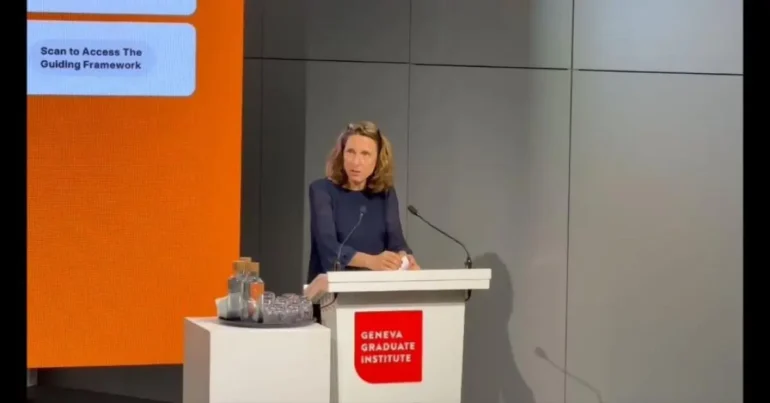

KABUL, AFGHANISTAN – Diké Poudzel, the European Union’s permanent representative to the United Nations Office in Geneva, has said the Taliban may have committed crimes against humanity through their treatment of women and girls in Afghanistan.
Poudzel made the remarks on Friday, September 4, at an event in Geneva launching a “Guidance Framework for Strengthening Accountability Mechanisms in Afghanistan.”
She said the alleged crimes could constitute gender persecution, describing the situation of Afghan women as one of “great suffering.” She added that men and boys were not entirely exempt from the consequences of the Taliban’s policies.
Poudzel said the situation of women and girls in Afghanistan has not received the sustained international attention it deserves.
She questioned how the world could remain unmoved by the systematic confinement and silencing of half of Afghanistan’s population, stressing that this stands in stark contrast to the Universal Declaration of Human Rights, which affirms that all people are born free and equal in dignity and rights.
The EU representative also cited examples of Taliban policies and laws, saying that girls have been deprived of education and left facing an uncertain future. She further alleged that Taliban legislation has allowed husbands to beat their wives under certain circumstances, provided the violence does not result in broken bones or bruising.
Poudzel said reports documenting the situation of women and girls in Afghanistan indicate that the Taliban may have committed crimes against humanity in the form of gender persecution.
The accountability framework launched at the event was developed by Women for Afghanistan, an organization led by Fawzia Koofi.
The organization said the framework was prepared following consultations with around 70 national and international organizations, women’s protest movements, human rights groups and other specialized organizations, in coordination with Richard Bennett, the UN Special Rapporteur on the situation of human rights in Afghanistan.
The framework aims to provide guidance on strengthening accountability mechanisms in Afghanistan, ensuring their effective use and promoting the participation of Afghan institutions and actors in accountability processes.
Koofi called for international mechanisms, including the International Criminal Court (ICC) and the International Court of Justice (ICJ), to be used more effectively to hold the Taliban accountable. She also urged the international community to recognize the Taliban’s policies restricting women and girls as “gender apartheid.”
Koofi said global solidarity with the Afghan people must go beyond statements and translate into political commitment, resources and concrete action. She also highlighted continued resistance by Afghan women, including through businesses, underground schools, online education, protests and documenting human rights violations.
Koofi said the Taliban have steadily pushed women out of public life over the past five years, but Afghan women have continued to resist by establishing businesses, running underground schools and online education programs, organizing protests, and documenting human rights abuses.
She called on the international community to take practical measures to support Afghan women in their efforts to reclaim their rights and challenge what she described as the Taliban’s instrumental and political use of religion and culture.

