

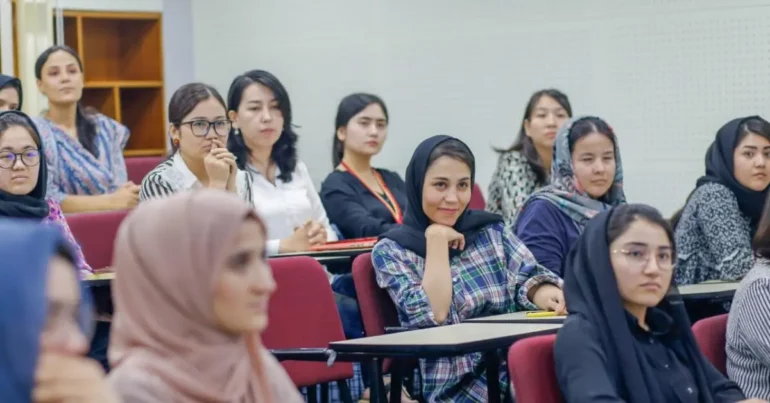

KABUL, AFGHANISTAN – More than five years after the Taliban banned girls and women from secondary and higher education in Afghanistan, the Asian University for Women (AUW), based in Chittagong, Bangladesh, has expelled a number of Afghan students, according to the students affected by the decision.
KabulNow spoke to two Afghan students who were expelled from the university. Both said they are survivors of attacks on the Sayed-ul-Shuhada School and the Kaaj Educational Center in western Kabul.
Sabira Mohammadi, one of the students, told KabulNow that the university has decided to expel at least 160 Afghan students.
She said the university had booked a plane ticket for her and informed her family that their daughter would be sent back to Afghanistan.
Zahra Mohammadi, another student, said she was deported to Afghanistan four days ago. She said she was also aware of at least eight other Afghan students who had been expelled.
Sabira said the university cited her “low average grade” at the end of the semester as the reason for her expulsion and communicated the same explanation to her family.
She said, however, that she has experienced seizures since the attack on the Sayed-ul-Shuhada School, in which she lost her younger sister. About 15 days before her final examinations, she suffered another severe seizure.
According to Sabira, the university took her to hospital following the seizure, where she remained for two days.
She said doctors advised her to remain in the hospital for a longer period, but she declined and sat for the exams. She added that the psychological and emotional difficulties she was experiencing affected her performance and resulted in poor final grades.
She added that the university initially suggested that she take a semester off and return to Afghanistan. After she rejected the proposal, she was summoned to the university office and told that she had to return to Afghanistan.
Zahra said the university cited “lack of progress” as the reason for her expulsion. She said she initially did not know English, but the university had not provided an adequate programme to help her overcome her language difficulties.
She said that after she was admitted to AUW, she was not assigned classes for about a year and a half and was only given classes during her final two semesters before being expelled.
The two students said they did not know the reasons given to other Afghan students for their expulsion because the university meets students individually and explains the decision privately to each student.
They said some students were still resisting the decision and remained on campus, demanding that the university provide a “reasonable explanation” for the expulsions. However, they said no general explanation had been publicly provided.
The students said they had asked university officials to allow them to continue their studies, but their requests were rejected.
The Asian University for Women is an independent international institution in Bangladesh established to provide higher education to women from across Asia. The university significantly expanded its admission of Afghan students after the Taliban returned to power in August 2021, when girls and women were increasingly excluded from Afghanistan’s education system.
AUW has previously said that it committed to bringing hundreds of Afghan women to Bangladesh after educational opportunities for women in Afghanistan were eliminated. In 2024, the university said more than 500 Afghan women were studying at AUW and that it had become the largest host of female Afghan students at a single institution.
The university also played a role in evacuating Afghan students after the Taliban takeover. In August 2021, about 160 Afghan students affiliated with AUW were evacuated from Afghanistan with assistance from the United States and the United Nations and later brought to Bangladesh.
The reported expulsions come as Afghan girls and women have virtually no access to formal education inside Afghanistan beyond primary school. The Taliban have barred girls from secondary schools and women from universities, while restrictions have also affected women’s access to medical education and other professional training.
The expulsions could therefore leave affected students facing a particularly difficult situation: returning to Afghanistan may mean losing access to the higher education they had been pursuing abroad.

