

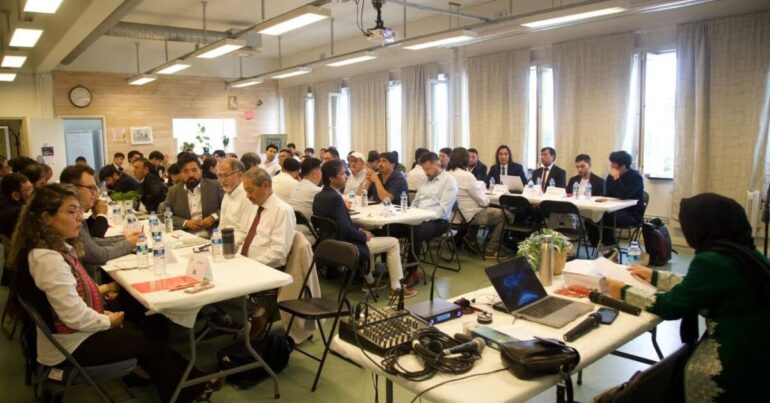

KABUL, AFGHANISTAN – The third forum of the Hazara Diaspora Network was held in Malmö, Sweden, focusing on the situation and needs of the Hazara diaspora community and the integration of newly arrived migrants into host societies.
The two-day gathering, titled “A Pathway Toward Integration and Participation in Host Societies,” began on Saturday August 1.
During the forum, the Hazara Diaspora Network honored renowned Afghan singer Dawood Sorkhosh for his “decades of valuable and continuous artistic and cultural contributions” and presented him with an appreciation award.
In its final declaration, participants strongly condemned all forms of violence and extremism, including religious and ethnic-based violence. They emphasized the need to confront hate speech, discrimination, violence, and social polarization.
Participants noted that the Hazara community has been among the major victims of religious and ethnic extremism in Afghanistan for decades and stressed that the community should not become a victim, tool, or means for promoting extremism and violence.
They called on Hazaras to play an active and constructive role in building safe, democratic, and inclusive societies in host countries by promoting peaceful coexistence, tolerance, human rights, equality, and civic participation.
The forum also highlighted the importance of integrating Hazara migrants into host societies while preserving their cultural identity and heritage.
Participants said that Hazaras can maintain their language, culture, and identity while contributing as active, responsible, and productive citizens in their host communities through participation in social, educational, economic, cultural, and civic fields.
The gathering particularly focused on the situation of young people, second-generation migrants, and newly arrived immigrants, emphasizing their access to education, language learning, employment, social services, and opportunities for civic engagement.
At the conclusion of the forum, the Hazara Diaspora Network called for cooperation from organizations, individuals, and activists to support migrants and advance shared goals.
Hazaras make up a significant portion of Afghan migrants in European countries and other parts of the world.
Hazaras, a distinct ethnic group and predominantly Shia, remain among Afghanistan’s most vulnerable communities. They have endured decades of targeted attacks, massacres, discrimination, and marginalization, with little protection or access to justice. Since the Taliban’s return to power in 2021, the situation has worsened, with rising attacks, systematic exclusion from education, employment, and public services, and limited security.
A report by Etilaatroz documented at least 61 targeted attacks on Shia Hazaras over 39 months of Taliban rule, leaving 473 dead and 681 injured, an average of nearly one death every three days and one injury every two days.
In recent years, repeated attacks by extremist groups, restrictions on their rights, and insecurity have forced many Hazaras to leave Afghanistan in search of safety, education, and a more secure future. Large numbers of Hazara migrants and refugees have settled in Europe, Australia, North America, and other parts of the world, where they continue to seek integration while preserving their cultural identity.

