

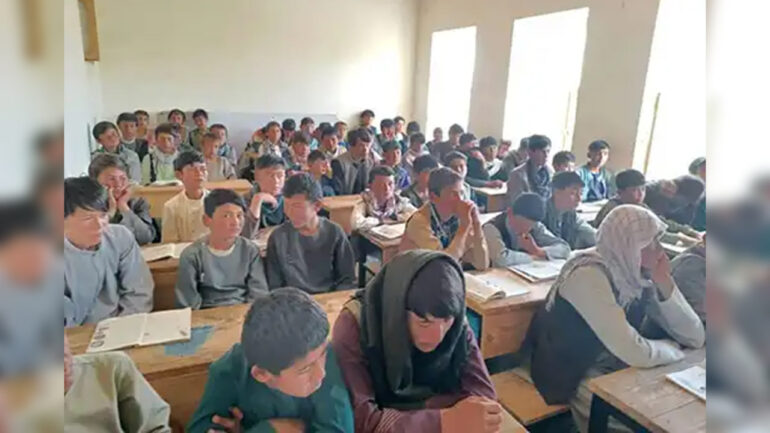

KABUL, AFGHANISTAN – Teachers in Afghanistan’s central Daikundi province have complained about what they describe as arbitrary decisions by the Taliban-run provincial education department in the redistribution of teaching positions among schools.
Sources among teachers in Daikundi told KabulNow that the lists prepared by district education offices and the provincial education department during the restructuring process were based on “personal preferences” when deciding which teachers should be transferred.
They said a number of female teachers from Shahristan and Miramor districts have been transferred to more remote areas, including Khadir, Ashtarly, Sang-e-Takht-o-Bandar, Kajran and Nili.
Several teachers who are dissatisfied with the transfer of their positions have filed complaints with the Daikundi education department.
A meeting was scheduled to be held today, Saturday, August 22, at the provincial education department in Nili. The teachers protesting the restructuring process are demanding that the department reconsider its decisions and take into account the conditions of schools and teachers.
The protesting teachers said the transfers have created particularly serious problems for female teachers because Daikundi is a mountainous province with difficult roads and long distances between districts.
At the same time, restrictions on women’s movement and, in many cases, the requirement that women be accompanied by a male relative make it extremely difficult—and in some cases practically impossible—for a female teacher to travel from Shahristan or Miramor to remote areas.
Documents obtained by KabulNow show that the Taliban-run Daikundi education department transferred 47 teachers between schools within Shahristan district and reassigned 19 teachers to other districts.
Among them, three female teachers were transferred from Shahristan to Kajran, two female teachers from Shahristan to Ashtarly, three female teachers from Shahristan to Sang-e-Takht-o-Bandar, and 10 female teachers from Shahristan to Nili, the provincial capital. Three male teachers were also transferred from Shahristan to Khadir.
The documents further show that four female teachers were transferred from Miramor to Nili, one female teacher from Miramor to Shahristan, and four female teachers from Miramor to Sang-e-Takht-o-Bandar.
According to the documents received by KabulNow, 16 teachers were reassigned among schools within Khadir district, 10 within Kajran, six within Nili, three within Ashtarly, and another three within Sang-e-Takht-o-Bandar.
In one specific case, three female teachers from Mamluq Girls’ High School in Shahristan were transferred to three different schools in Kajran. One teacher from the same school was transferred to Sayyed Ahmad Girls’ School in Shahristan, while another was transferred to Gowshakh Mixed School in the district. In return, one female teacher from Tagab Girls’ High School in Miramor was transferred to Mamluq Girls’ High School in Shahristan.
A teacher also told KabulNow that individuals with connections within the Taliban-run education department had allegedly influenced the process of preparing the transfer lists, resulting in corruption in the restructuring of teaching positions.
The teacher, who requested anonymity, alleged that in two cases, a teacher from Chogani School was transferred to Talash School in Nili, while another teacher from Sar-e-Nili School was transferred to Resalat School. The source claimed that both female teachers were able to influence the transfer process because their husbands work as employees of the Daikundi education department.
The changes and redistribution of teachers’ positions were carried out under the “Guideline for Resolving Problems in the Education Staffing Structure.”
The guideline, issued by the Taliban’s Ministry of Education this solar year and sent to education departments across the provinces and Kabul, requires local education authorities to review the staffing structures of all schools.
Under the guideline, a committee made up of education officials is tasked with reducing or increasing teaching positions based on the number of students and active classes at each school.
The guideline allocates one teacher for each active class at a school. It stipulates that if a school has more than one teacher per active class, excess positions should be eliminated and transferred to schools with insufficient staffing.
However, teachers in Daikundi complain that the provincial education department has failed to consider the actual needs of schools and students, as well as the circumstances of teachers, when reducing and increasing teaching positions.
They said female teachers are unable to continue working in more remote districts and called for the actual circumstances of teachers to be assessed so that a fair solution can be found—one that protects teachers’ rights while preventing disruption to education in Daikundi’s schools.
Previously, the Taliban transferred 50 teaching positions from other districts of Daikundi to Pato district. As a result, some teachers were forced to resign, while others left their jobs entirely.
Some of the transferred teachers have said that their low teaching salaries are largely spent on their daily expenses in Pato, leaving them with nothing to send to their families.
Last year, KabulNow reported that despite a shortage of education staffing positions across Daikundi, the Taliban had eliminated 28 positions from the central administration of the provincial education department and 120 teaching positions from other parts of the province.
The latest complaints highlight the broader challenges facing Daikundi’s education system, where administrative decisions over teacher deployment can have a direct impact on students’ access to education.
In a mountainous province where transportation is difficult and many communities are separated by long distances, transferring teachers without considering local conditions could deepen existing staffing shortages and make it especially difficult for female teachers to remain in their jobs.
The dispute also raises questions about transparency and accountability in the Taliban’s management of public education services, particularly when teachers allege that personal connections and favoritism have influenced staffing decisions.
Since returning to power in August 2021, the Taliban have significantly reshaped Afghanistan’s education system. Girls have been barred from attending secondary schools beyond Grade 6, while women have also been banned from universities and most forms of higher education.
The Taliban have introduced changes to school curricula and increased the emphasis on religious education, including the teaching of Islamic subjects and the Hanafi school of jurisprudence. The authorities have also revised textbooks and educational content, while placing greater emphasis on religious instruction and what they describe as Islamic values.
These policies have fundamentally changed access to education, particularly for girls and women, and have raised concerns among the United Nations, human rights organizations and education advocates about the long-term impact on Afghanistan’s education system and the country’s future workforce.

