

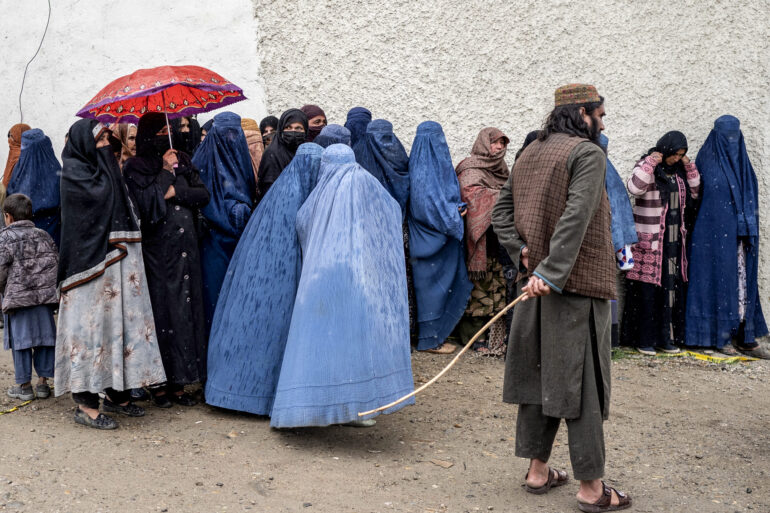

KABUL, AFGHANISTAN – The Taliban authorities in Afghanistan have issued a new law declaring obedience to the group’s supreme leader, Hibatullah Akhundzada, obligatory and placing decisions on jihad under his exclusive authority, while also establishing a range of provisions governing women, marriage and family relations.
The Ministry of Justice published the new law, titled “Nisab-e Muballighin” (Preachers’ Curriculum), on Sunday, August 16. The six-chapter document, endorsed by Akhundzada, sets out religious teachings that Taliban preachers are required to communicate to the public through mosques, sermons and other religious gatherings.
It covers issues ranging from religious obligations and rituals to jihad, obedience to the Taliban leader, marriage, women’s rights and responsibilities, and hijab.
Under the provisions concerning marriage, the law requires women to obey their husbands and describes men as the “rulers” of their wives. It also instructs women to keep their husbands “happy” and appreciate their husbands’ acts of kindness. In return, husbands are required to provide their wives with food, clothing and housing and to pay their dowry.
The law recognizes polygamy as permissible, stating that men with several wives must treat them fairly. At the same time, it instructs men not to commit injustice or coercion against women. The document says the consent of an adult woman is necessary for marriage and that no one may force her into marriage. It also rejects the practice of “Baad”, under which women or girls are given to another family as compensation for a dispute or crime, stating that a woman is not property and cannot be given away in this manner.
The law further says that a widow is not obliged to marry her deceased husband’s brother and that she is entitled to receive a dowry if she remarries. On inheritance, the document distinguishes between equality in gifts from parents and inheritance, stating that equality between sons and daughters when parents give them something does not apply to inheritance.
The law also places responsibility on men to enforce hijab among women under their guardianship. In a section dedicated to “covering and hijab,” preachers are instructed to explain the distinction between mahram and non-mahram individuals and to tell men to require women under their care to observe hijab in the presence of non-mahram men.
Jihad (a religious term that can refer to struggle or armed religious warfare, depending on the context) is another central theme of the new curriculum.
Taliban preachers are instructed to teach the public about the definition, intention and virtues of jihad and to explain the qualities and conduct expected of a mujahid. They are also told to encourage people to prepare for jihad and support fighters. The document describes being wounded or killed in jihad as a “virtue” and instructs preachers to encourage people toward “martyrdom.”
It also directs preachers to teach religious practices including prayer, fasting, ablution, ritual bathing, pilgrimage, zakat and ushr, while warning people of punishment for failing to fulfill certain religious obligations.
One of the most significant provisions concerns obedience to the Taliban’s supreme leader. The law states that obedience to the emir is obligatory even if the emir is not a righteous person. It says that authority over matters of jihad belongs to the “Imam (Emir of the Faithful)” and that no individual should take action on such matters without the emir’s consultation and approval.
The document further states that obedience to the emir is obligatory in permissible matters regardless of whether an individual agrees with his orders, and that obedience is also required toward people appointed by the emir. Preachers are instructed to tell people that if an order from the emir is contrary to their personal nature or wishes, they should exercise patience.
The Taliban call their administration an Islamic system. The group claims to follow Sharia law, but its restrictions do not exist in any other Islamic society or country. Experts accuse the Taliban of exploiting religion for political purposes.
Hibatullah Akhundzada is the supreme leader of the Taliban and holds the highest authority in the group’s decision-making structure, particularly on religious, political, and governance matters.
Since the Taliban returned to power in 2021, his leadership has been central in shaping the direction of the government, especially through strict interpretations of Islamic law and centralized control over policy decisions from Kandahar.
In general, the Taliban government has implemented a range of policies based on its interpretation of Sharia, which has significantly affected different aspects of public life in Afghanistan. These include restrictions on education and employment for women and girls, limitations on media freedom, and strict social regulations.
In particular, women have been barred from secondary and higher education in most cases and face severe restrictions on work and public participation, which has drawn widespread domestic and international criticism.
In August 2024, the Taliban formally codified a number of existing restrictions through their Law on the Propagation of Virtue and Prevention of Vice, which further regulated women’s clothing, movement and public conduct and expanded the authority of morality-policing officials.
Internationally, the Taliban administration remains largely unrecognized by most countries, and its policies have been a point of concern for the global community, especially human rights organizations and the United Nations.
Many governments have called for the reversal of restrictions on women’s rights and broader political inclusivity. At the same time, the Taliban continues to emphasize that its system is based on Islamic principles and seeks internal legitimacy through religious governance rather than external approval.

