

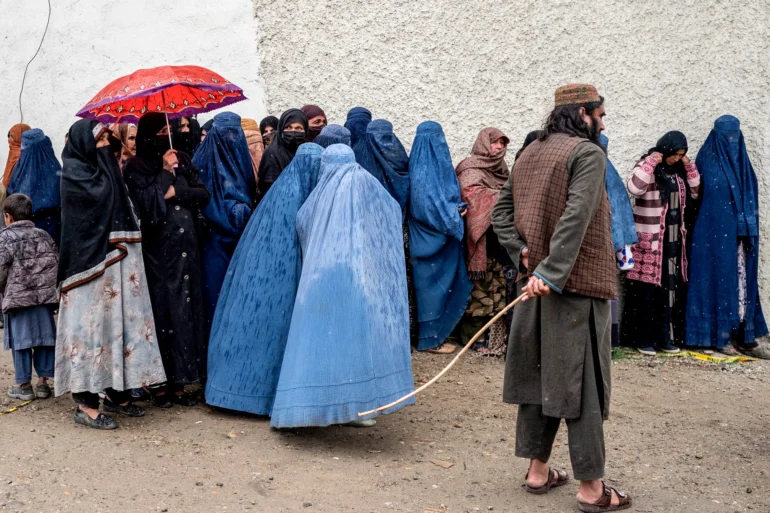

KABUL, AFGHANISTAN – As Afghanistan marks the fifth anniversary of the Taliban’s return to power, Amnesty International has urged the US government to lead international efforts to protect Afghan women and girls and hold the Taliban accountable for human rights violations.
In a statement issued on Saturday, August 15, Amnesty International said that five years after returning to power, the Taliban continue to commit serious violations against women and girls with little to no accountability.
The organization said the scale of discrimination affecting an estimated 21.7 million women and girls in Afghanistan is alarming. Women and girls are currently deprived of access to education, employment and freedom of movement, while Taliban authorities have detained women and girls over their clothing.
Amnesty International said the Taliban have established a system of domination based solely on gender that effectively controls almost every aspect of women’s lives.
“For years, the international community failed to deliver a proportionate response to this oppression,” the organization said, adding that the failure of the United States is particularly concerning because Washington has long recognized, with bipartisan support, its responsibility toward the Afghan people.
Amnesty called on the US government to lead international efforts to support Afghan women and girls and ensure accountability for Taliban abuses.
The organization also urged the United States and the international community to stop normalizing the Taliban’s repression rather than accepting the current situation in Afghanistan.
According to Amnesty, many governments have established diplomatic and economic channels with the Taliban. It pointed to the Taliban’s invitations to Europe, warning that such engagement, if it ignores ongoing human rights violations, risks normalizing the group’s repression and implicitly accepting crimes under international law.
Amnesty said normalization sends a troubling message to Afghan women and girls: first, that their human rights are secondary to the diplomatic and economic interests of governments; and second, that repressive regimes can commit serious violations without facing consequences.
The organization stressed that the international community must ensure that its engagement with the Taliban does not legitimize or normalize the systematic repression of women and girls.
Amnesty also called on the US government and the international community to develop a clear, rights-based foreign policy toward Afghanistan.
The organization said the current US administration’s Afghanistan policy remains “under review,” creating an unacceptable level of uncertainty on an issue that should be a priority. Amnesty urged the Trump administration to establish a clear Afghanistan policy centered on human rights, including the rights of women and girls.
The organization further called on the United States to provide security and legal certainty for Afghans who previously worked with or supported US forces.
“Afghan allies are trapped between two realities,” Amnesty said. Many are facing prolonged legal uncertainty and the risk of deportation in the United States, while those in Afghanistan face the threat of persecution and retaliation by the Taliban.
Amnesty urged the US government to provide protection and legal certainty to Afghans at risk of persecution under Taliban rule, both those currently in the United States and those waiting for protection outside the country.
The organization also called on the US Congress to pass the Afghan Adjustment Act, which has bipartisan support, to create a pathway to permanent residency for eligible Afghan nationals in the United States.
Amnesty further urged Congress to support and pass the Afghan Temporary Protected Status Act, which would protect eligible Afghans currently in the United States from deportation.
Amnesty International is a global human rights organization that investigates and documents human rights abuses and campaigns for justice, accountability and the protection of fundamental freedoms worldwide.
The organization’s call comes five years after the Taliban seized Kabul on August 15, 2021, ending the Islamic Republic. Since then, the Taliban have imposed sweeping restrictions on women and girls, including bans on secondary and higher education, restrictions on employment and movement, and exclusion from many areas of public life. Human rights organizations and UN experts have described the systematic discrimination and exclusion of women and girls under Taliban rule as gender apartheid.

