

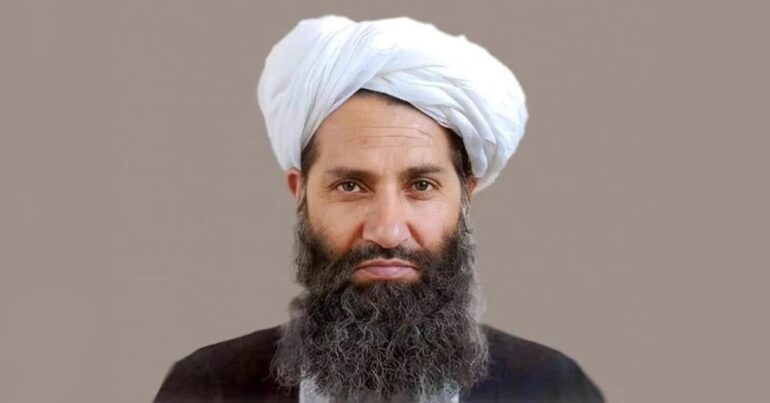

KABUL, AFGHANISTAN – Taliban Supreme Leader Hibatullah Akhundzada has called on religious scholars in Kandahar to work toward strengthening a culture of “obedience” among themselves and the public.
Akhundzada made the remarks during a meeting held on Wednesday with religious scholars from districts and urban areas of Kandahar province. Addressing the gathering, he urged clerics to promote obedience in society, saying that doing so would strengthen unity and prevent “discord and unrest.”
Akhundzada urged religious scholars to promote a stronger culture of obedience within their own ranks and among the public, saying that this would help reinforce unity and prevent divisions and conflicts.
He claimed that “the Islamic system” had been established in Afghanistan and said allegiance to the “legitimate Islamic leader” had come through consensus among Muslims and through jihad. He called on religious scholars to maintain mutual trust and cooperation so that, according to him, enemies would not be able to create divisions among them.
Akhundzada also urged religious scholars in Kandahar to fully cooperate with the Taliban, discourage people from what he described as “meaningless activities,” influence public thinking, and inform citizens about Taliban laws and regulations.
Since the Taliban returned to power in August 2021, Akhundzada has repeatedly emphasized obedience to Taliban orders and allegiance to his leadership. His calls for loyalty have been a central theme in many of his speeches to religious scholars and Taliban officials.
The remarks come as the Taliban administration continues to face a lack of domestic and international recognition nearly five years after taking control of Afghanistan. Apart from Russia, no other country has formally recognized the Taliban government. The group has also faced widespread criticism over restrictions on women’s rights, media freedoms, and civil liberties, which have contributed to its continued diplomatic isolation.
Hibatullah Akhundzada is the supreme leader of the Taliban and has been the group’s highest authority since 2016, following the death of former Taliban leader Mullah Akhtar Mansour. Originally from Kandahar province, Akhundzada has a background as a religious scholar and previously served as a senior figure responsible for judicial and religious affairs within the Taliban.
After the Taliban regained control of Afghanistan in August 2021, he became the country’s most powerful figure, although he has remained largely out of public view and rarely appears in official events.
Since taking power, Akhundzada has issued numerous decrees and directives shaping the Taliban’s governance policies, including orders related to religious, social, and political matters. He has repeatedly called on Taliban officials, religious scholars, and the public to follow the group’s decisions and show loyalty through what he describes as obedience and allegiance.
In his latest remarks in Kandahar, he urged religious scholars to strengthen a culture of obedience among themselves and the population, cooperate with the Taliban authorities, promote the group’s laws, and influence public attitudes in line with Taliban policies. His emphasis on obedience and allegiance has become a recurring theme in his speeches as the Taliban continues to govern Afghanistan without broad international recognition.

