

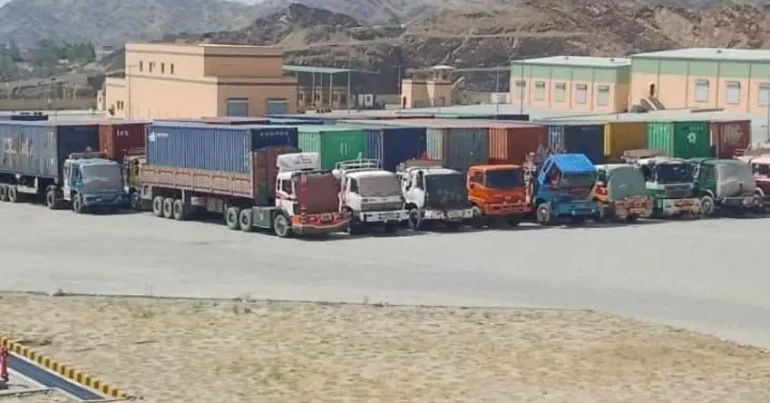

KABUL, AFGHANISTAN – Local Taliban authorities in eastern Afghanistan say that 56 trucks carrying United Nations humanitarian aid entered Afghanistan through the Torkham border crossing with Pakistan on Tuesday.
Quraishi Badloon, head of information at the Taliban’s Directorate of Information and Culture in Nangarhar Province, said the convoy entered the country on Tuesday morning following coordination between Taliban authorities and Pakistan.
According to Badloon, the trucks were transporting humanitarian supplies from the World Health Organization (WHO) to Afghanistan.
He also claimed that Pakistani authorities charged the World Health Organization a fee for each truck in exchange for allowing the convoy to cross the border.
The Torkham border crossing has remained largely closed for nearly a year, with no regular overland trade or civilian travel taking place between Afghanistan and Pakistan.
Despite the closure, Pakistan has continued to allow the passage of deported Afghan migrants and, in some cases, United Nations humanitarian aid convoys through the border.
Meanwhile, the delivery highlights the complex relationship between Pakistan and the Taliban authorities since the Taliban’s return to power in Afghanistan in 2021. Although political and security tensions between the two sides have frequently escalated over border management, militant activity, and the forced deportation of Afghan migrants, Pakistan has continued to coordinate with Taliban authorities on selected cross-border matters.
In recent months, Islamabad has allowed the passage of some United Nations humanitarian aid convoys and deported Afghan nationals through the Torkham crossing despite broader restrictions on trade and civilian movement.
Afghanistan is currently facing one of the world’s worst humanitarian crises. According to the United Nations, more than 23 million people—over half the population—require food aid, while aid cuts, donor fatigue, and political isolation have forced the closure of over 400 health facilities.
The UN has appealed for $1.7 billion to respond to the crisis; however, according to its reports, less than 15 percent of this amount has been funded so far.
Malnutrition continues to be a major concern. The World Food Programme estimates that about 3.7 million children and 1.2 million pregnant and breastfeeding women will face acute malnutrition in 2026.
The delivery comes as humanitarian agencies continue to warn that millions of Afghans remain in need of life-saving assistance amid an ongoing humanitarian crisis driven by economic hardship, climate-related shocks, and reduced international aid. Cross-border access through key crossings such as Torkham remains essential for delivering medical supplies and other humanitarian assistance to vulnerable communities across Afghanistan.

