

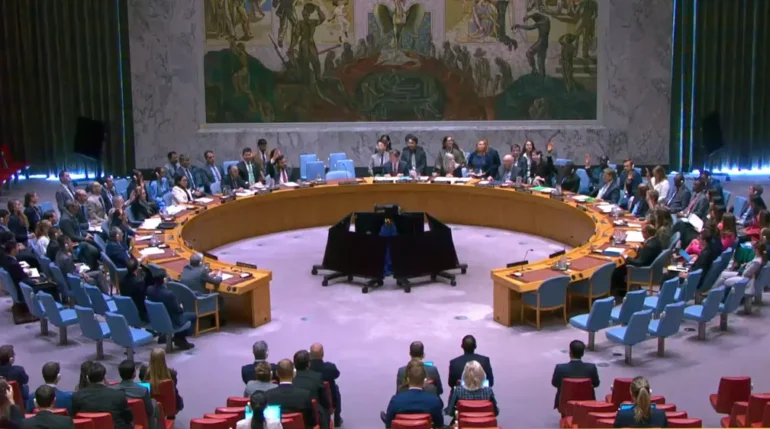

KABUL, AFGHANISTAN – The United Nations Assistance Mission in Afghanistan (UNAMA) says that the United Nations Security Council is scheduled to hold a special meeting on Afghanistan tomorrow (Monday, June 8).
At the meeting, Georgette Gagnon, Deputy Special Representative and Acting Head of UNAMA, will present a report on the situation in Afghanistan to the UN Security Council.
The meeting will be held at 6:30 p.m. Kabul time on Monday.
Another meeting is also expected to be held one week later to discuss the extension of UNAMA’s mandate in Afghanistan.
The last UN Security Council meeting on Afghanistan was held four months ago, during which UNAMA’s mandate was extended for three months and Georgette Gagnon described the situation in Afghanistan as “bad.”
Ms. Gagnon said that the Taliban’s restrictions on women’s education and employment have affected not only women and girls but society as a whole, while declining humanitarian assistance has made it more difficult for aid organizations to respond to “growing poverty and hunger.”
However, concerns have been raised about the effectiveness of UNAMA’s work when its mandate is renewed for only short periods. Following the UN Security Council’s decision in March 2026 to extend the mission’s mandate for just three months, Amnesty International criticized the move, arguing that it undermined sustained international monitoring of human rights in Afghanistan.
The organization stated that a longer renewal would have provided greater stability and predictability for UNAMA to carry out key responsibilities, including documenting human rights conditions and implementing its Women, Peace and Security agenda.
The upcoming Security Council session comes at a time when Afghanistan continues to face significant humanitarian, economic, and human rights challenges. Discussions at the UN are expected to focus on the country’s worsening humanitarian conditions, the rights of women and girls, regional stability, and the future role of UNAMA in supporting the Afghan people and engaging with the de facto authorities.
The United Nations Assistance Mission in Afghanistan (UNAMA) plays a central role in coordinating the UN’s engagement with Afghanistan and serving as a bridge between the international community and the country’s de facto authorities. Established in 2002, UNAMA has supported political dialogue, monitored human rights, facilitated humanitarian coordination, and assisted international efforts aimed at promoting peace and stability.
Since the Taliban’s return to power in 2021, the mission has become even more significant because it remains one of the few international bodies with a continuous presence across Afghanistan. As a result, UNAMA provides the United Nations and member states with regular assessments of political, economic, humanitarian, and human rights developments in the country.
Moreover, UNAMA plays a critical role in advocating for the rights of women and girls, documenting human rights concerns, and helping humanitarian agencies reach vulnerable communities. At a time when millions of Afghans depend on humanitarian assistance and the country faces severe economic and social challenges, the mission serves as an important channel for dialogue and international engagement.
Furthermore, UNAMA helps coordinate the work of UN agencies operating in Afghanistan and supports efforts to prevent further instability. Consequently, many governments and international organizations view the continuation of UNAMA’s mandate as essential for maintaining international oversight, delivering assistance to those in need, and encouraging constructive engagement on key issues affecting Afghanistan’s future.

