

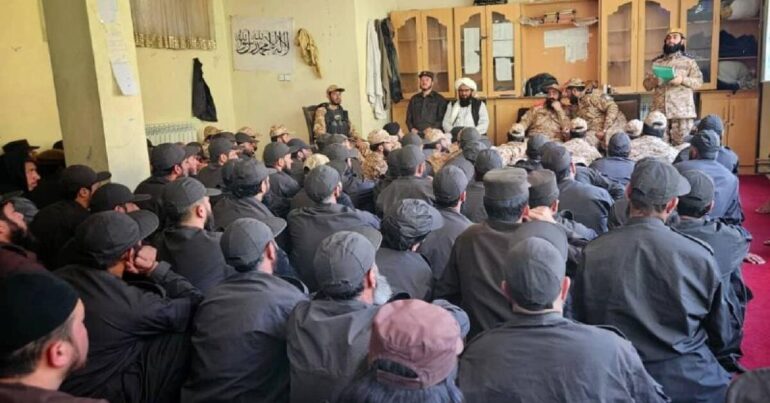

KABUL, AFGHANISTAN – Local sources told KabulNow that the Taliban have dismissed 70 former security personnel and young men from Panjshir from their positions in the province’s police command.
Reliable sources confirmed on Monday (June 9) that all of those dismissed had either served in the security forces under the former republic or are native residents of Panjshir.
The Taliban have stated that the reason for their dismissal was that their positions were “surplus posts.”
However, sources who spoke to KabulNow on condition of anonymity said that these individuals’ “service to the republic” and their “ethnic and regional affiliation” were the real reasons behind their removal.
According to the sources, in recent months Pashtun youths affiliated with the police command have been recruited into the “newly established Shahra Battalion” in Panjshir, while Tajik individuals have been dismissed under various pretexts.
Last year, the Taliban also abolished 20 percent of the group’s police force positions in Panjshir, describing them as “surplus posts,” with the majority of those dismissed being local residents.
After regaining power in Afghanistan, the Taliban initially recruited personnel from among local residents. However, after some time, they launched a process referred to as the “purification of military ranks.”
Under this process, which is still ongoing, individuals who do not have a history of serving with the Taliban during the group’s war against the former republic and NATO forces between 2001 and 2021 are removed from their positions.
The reported dismissals in Panjshir come amid continued concerns over employment practices and representation within Taliban institutions. Critics argue that the removal of former republic personnel and local residents may further deepen grievances in regions where tensions between local communities and the Taliban authorities have remained high since the group’s return to power.
Panjshir, a mountainous province northeast of Kabul and historically a stronghold of resistance against the Taliban, has been subject to ongoing security operations and restrictions. In recent years, the Taliban have detained dozens of residents, including activists, journalists, and teachers, on various charges, such as alleged links to armed groups or possession of weapons.
In addition, when the Taliban took control of Afghanistan in 2021, they faced armed resistance in Panjshir. Resistance forces, including the National Resistance Front of Afghanistan, have repeatedly clashed with Taliban forces in the province. The group claims that it continues to maintain a presence and influence in Panjshir.
Human rights organizations, including Amnesty International, have documented patterns of arbitrary arrests, torture, and collective punishment in Panjshir, describing some Taliban actions there as potential war crimes. The group has faced similar accusations of detaining and mistreating former government officials and security personnel across Afghanistan.
The new restrictions come amid ongoing security concerns in Panjshir. Although large-scale fighting has decreased compared to previous years, reports of security operations, arrests, and occasional clashes continue to emerge from the province, underscoring the Taliban’s efforts to maintain control over an area historically associated with resistance movements.

