

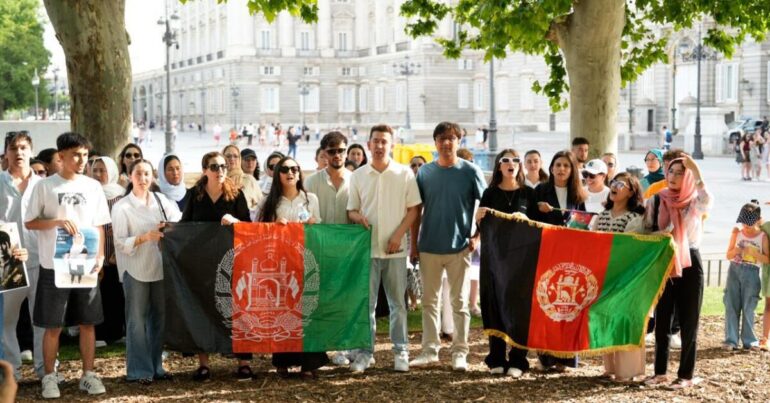

KABUL, AFGHANISTAN – A number of Afghan migrants in the United States, Switzerland, Spain, and Canada held protests in support of women in Afghanistan under Taliban rule.
Protesters in Washington chanted “Education, Work, Freedom” and called for the recognition of gender apartheid in Afghanistan.
In Switzerland, Afghan migrants gathered in front of the United Nations office in Geneva.
Participants in the gathering expressed solidarity with Afghan women and girls, described the Taliban’s policies and actions as “gender apartheid,” and condemned the violent suppression of peaceful public protests in the Jebrail area of Herat.
They called for the recognition of gender apartheid as a crime against humanity.
The protesters emphasized that governments and international institutions should refrain from normalizing political and diplomatic relations with the Taliban, and that any official engagement with the group should be conditional upon respect for human rights and the restoration of the rights of women and girls.
Afghan migrants in the cities of Bilbao and Madrid also demonstrated in support of women inside the country.
In a statement issued in Madrid, protesters expressed deep concern over the deteriorating human rights situation in Afghanistan, particularly the widespread and systematic violations of the rights of women and girls under Taliban rule.
They said that the systematic deprivation of women’s rights to education, employment, freedom of movement, social and political participation, access to justice, and other fundamental rights constitutes a clear example of structural discrimination, widespread human rights violations, and contains the legal elements of gender apartheid. They added that these measures violate international obligations, particularly the principles of equality and non-discrimination.
They called on the Human Rights Council, Special Rapporteurs, international institutions, and governments to recognize the Taliban’s policies against women as gender apartheid.
Protesters in Madrid, Spain, also called for the initiation of a formal legal review, documentation, and recognition process regarding targeted violence against the Hazara community as genocide.
They emphasized that Tajik, Uzbek, Turkmen communities, Shia Muslims, and religious minorities such as Sikhs and Hindus are also victims of structural discrimination, cultural exclusion, and organized persecution by the Taliban, and urged the international community to document, investigate, and ensure accountability for these cases as well.
A number of human rights defenders and civil society activists in Calgary, Canada, stated that Afghan women are victims of gender apartheid.
They stressed that the international community should break its silence, recognize gender apartheid, and take practical measures to support Afghan women.
Previously, Afghan citizens in several countries around the world had also protested against the situation of women and girls inside Afghanistan.
Gender apartheid refers to a system of institutionalized discrimination and segregation based on sex, in which women and girls are systematically denied fundamental rights and freedoms. Human rights advocates and legal experts have increasingly used the term to describe the situation in Afghanistan, where Taliban policies have restricted women’s access to education, employment, public life, freedom of movement, and political participation.
Supporters of the term argue that these measures constitute a deliberate and systematic effort to exclude women from society and should be recognized under international law as a crime against humanity.
The protests followed an initial demonstration on June 9 in Herat’s predominantly Hazara-populated Jibrail Neighbourhood, which erupted after days of mounting public anger over the detention of women. During that protest, Taliban forces reportedly opened fire directly on the crowd and beat demonstrators, killing at least one child and injuring around 20 others, according to local sources and videos.
Morteza Karimi, one of the individuals injured during public demonstrations in the Jebrail area of the city, died five days ago. Local sources reported that his burial was conducted under heavy Taliban surveillance, with intelligence agents monitoring the funeral proceedings. According to the sources, the Taliban also restricted public commemorations and prevented Karimi’s family from referring to him as a “martyr” or displaying signs bearing that title.
Following the first protest, the Taliban deployed hundreds of armed fighters equipped with light weapons, rockets, and tanks across Herat and set up multiple checkpoints on major routes. Similar security measures were implemented in Kabul’s Dasht-e-Barchi, a Hazara-populated neighbourhood in western Kabul, where large numbers of troops and military vehicles were positioned to head off potential unrest. No protests were reported in Kabul as of Friday evening.
The Taliban’s use of force against peaceful demonstrators and the detention of women and girls have also drawn strong international condemnation. The United Nations, human rights organizations, politicians, and citizens worldwide have called on the group to stop the violence against peaceful protesters and immediately release all detained women and girls.
Since returning to power in 2021, the Taliban have imposed sweeping restrictions on women’s education, employment, movement, and participation in public life. Activists argue that continued international pressure and sustained global attention are essential to preventing further erosion of women’s rights and ensuring that the voices of Afghan women remain at the center of discussions about Afghanistan’s future.

