

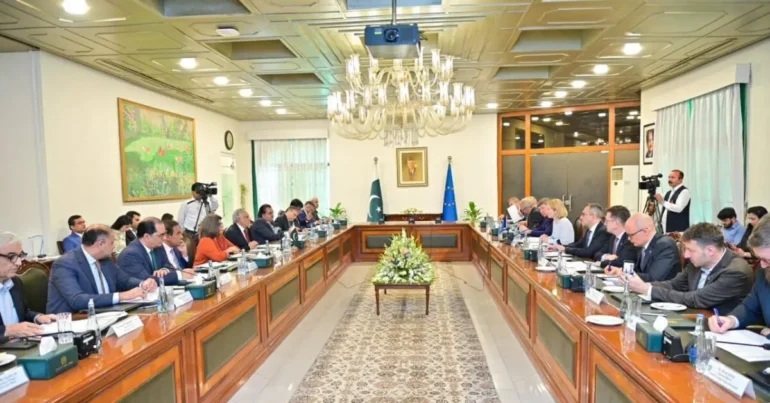

KABUL, AFGHANISTAN – Pakistan and the European Union have addressed the situation in Afghanistan in a joint statement, expressing concern over the presence of terrorist groups and the deteriorating human rights situation in the country.
The statement was issued on (Monday, June 1) at the conclusion of the eighth round of the Pakistan-European Union Strategic Dialogue held in Islamabad. The meeting was co-chaired by Kaja Kallas, the European Union’s High Representative for Foreign Affairs and Security Policy, and Ishaq Dar, Pakistan’s Foreign Minister.
According to the statement, Pakistani and European officials exchanged views on the situation in Afghanistan and emphasized the importance of combating terrorism in all its forms and manifestations, in accordance with international law and relevant United Nations Security Council resolutions.
They expressed serious concern regarding the presence of terrorist entities in Afghanistan and reiterated that Afghan territory must not be used to threaten or attack other countries.
European and Pakistani officials called on the Taliban authorities in Afghanistan to take effective and verifiable measures against all terrorist groups operating in Afghanistan or using Afghan territory.
Militant violence has surged across Pakistan in recent years, with the northwestern Khyber Pakhtunkhwa and southwestern Balochistan provinces — both bordering Afghanistan — seeing the highest number of attacks. The TTP and Baloch separatist groups have stepped up attacks on security forces and state installations.
Islamabad accuses the Afghan Taliban authorities of harbouring TTP fighters and allowing them to use Afghan territory to plan and launch cross-border attacks. The Taliban rejects these allegations, maintaining that Pakistan’s security challenges are an internal issue and that no such groups operate from Afghan soil.
On the surface, the Taliban have sought to distance themselves from involvement in the TTP’s conflict with the Pakistani government. Last year, they organized a large gathering of religious scholars in Kabul and issued a religious decree stating that participating in “jihad” outside Afghanistan is “not obligatory.”
Tensions between Islamabad and Kabul have escalated sharply since late 2025, marked by dozens of border clashes, Pakistani airstrikes inside Afghanistan — including targets in Kabul and Kandahar — and retaliatory actions. The exchanges have resulted in hundreds of casualties on both sides, including civilians.
The joint statement noted that the European Union had called for de-escalation, the resolution of security concerns, and adherence to international law.
Concerns Over the Deteriorating Human Rights Situation
European and Pakistani officials also expressed concern in their joint statement about the worsening human rights situation in Afghanistan, particularly the rights of women and girls.
The statement referred to restrictions on fundamental freedoms, access to education, participation in public life, as well as freedom of expression and freedom of the press in Afghanistan.
The Taliban have imposed severe restrictions on the rights and freedoms of citizens, especially women and girls. For nearly five years, women and girls have been deprived of work and education.
Furthermore, concerns about the rights and safety of women and girls in Afghanistan have been reinforced by a recent report from the United Nations Secretary-General. The report, submitted to the UN Security Council three days ago, stated that UNAMA documented 21 cases of conflict-related sexual violence against 15 women and six girls during the past year, including rape, gang rape, forced marriage, and forced nudity.
The incidents were attributed to Taliban officials, including members of the group’s security forces.
The report also noted that women who challenge Taliban policies have faced arbitrary detention and sexual violence, while funding cuts and restricted humanitarian access have weakened protection mechanisms and reduced access to medical, psychosocial, and legal support for survivors.

