

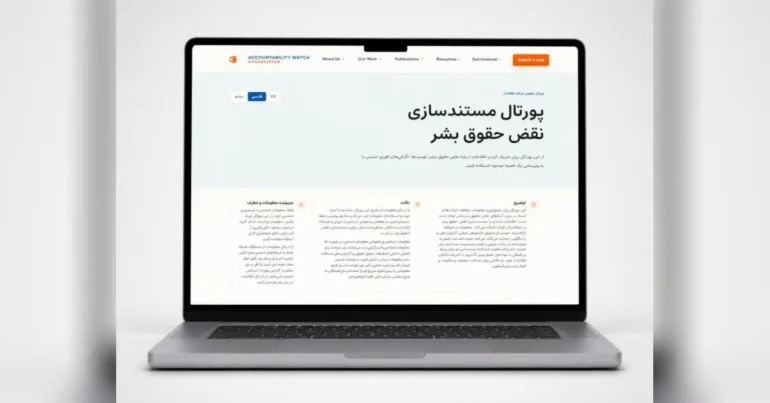

KABUL, AFGHANISTAN – The “Afghanistan Accountability Watch” has announced the launch of a “Human Rights Violations Documentation Portal” in Afghanistan.
This organization said that the portal has been created “to collect information, evidence, testimonies, and documents regarding alleged cases of human rights violations and abuse in Afghanistan.”
The website of this organization states that “the information and materials submitted for the purpose of documenting human rights violations, identifying patterns of violations, supporting investigations, advocacy, reporting, and accountability efforts, as well as protective actions, will be securely stored, verified, and analyzed.”
The “Afghanistan Accountability Watch” added that, in appropriate cases, it may refer eligible cases to national and international human rights mechanisms; however, submitting cases through this portal “does not guarantee immediate intervention or action, nor the provision of direct assistance.”
The organization said that all submitted information will be kept in accordance with privacy laws and that “no information will be disclosed to any person or third party without the explicit permission of the sender(s).”
People can submit human rights violation cases to the “Afghanistan Accountability Watch” by filling out an online form and uploading documents and evidence.
Since the Taliban regained control of Afghanistan, widespread cases of human rights violations have been reported in various provinces of the country, but due to severe restrictions imposed by the Taliban, many of these cases have not been documented.
This initiative is considered an important step toward creating a structured system for recording and preserving evidence of human rights abuses in Afghanistan, which may later support accountability processes, international reporting, and future justice efforts.
Since the Taliban regained control of Afghanistan, numerous reports from different provinces have documented widespread human rights violations. These include restrictions on freedom of expression, education, and movement, particularly targeting women and girls. Many international organizations and local witnesses have also reported that enforcement of these restrictions is often carried out through intimidation, arbitrary detention, and the use of force, creating an environment of fear and limiting basic civil liberties.
The United Nations Assistance Missions in Afghanistan (UNAMA) says that from the Taliban’s return to power in August 2021 until March 2024, it documented 1,033 instances (205 on females, 828 on males) where the Taliban morality police used force while enforcing their instructions.
Meanwhile, Zaman Sultani, Amnesty International’s regional researcher for South Asia, says, “The arbitrary, inconsistent, and ambiguous record of morally policing the people of Afghanistan, with an institutionalized system of discrimination that disproportionately impacts women and girls, has had a decaying effect on human rights in the country.”
In addition the Taliban have imposed severe restrictions on women’s rights in Afghanistan, limiting their access to education, employment, and freedom of movement. Women and girls have been banned from secondary and higher education in many areas, and strict rules on dress code and public behavior are enforced through fear and punishment.
These policies have significantly reduced women’s participation in public life and are widely criticized by human rights organizations as a form of gender discrimination and systematic oppression.

