

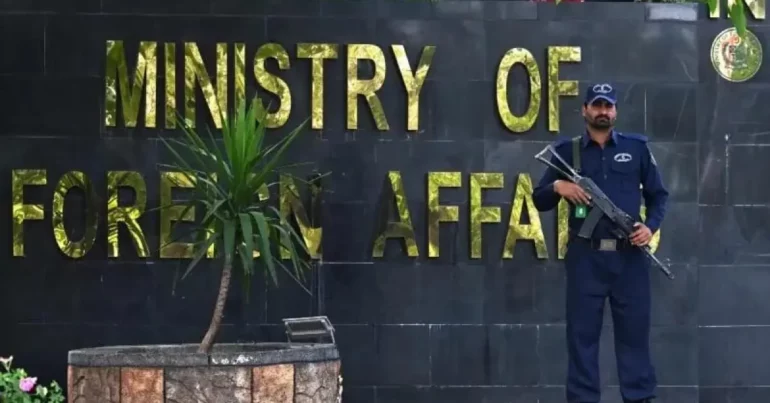

KABUL, AFGHANISTAN – Pakistan’s Ministry of Foreign Affairs has summoned Sardar Ahmad Shakib, the Taliban chargé d’affaires in Islamabad, in response to the attack on a police checkpoint in Bannu district of Khyber Pakhtunkhwa and formally conveyed Pakistan’s strong protest.
In a statement issued today (Monday, May 11), Pakistan’s Foreign Office said: “The Ministry conveyed that a detailed investigation into the incident, along with evidence collected and technical intelligence, indicates that the attack was masterminded by terrorists residing in Afghanistan.”
The “Fateh Khel” checkpoint in Bannu district of Pakistan’s Khyber Pakhtunkhwa province was targeted in a suicide and armed attack on Saturday night, killing at least 15 police personnel and injuring four others, including one civilian.
Pakistan’s Foreign Ministry said the attack was carried out by “Fitna al-Khawarij,” a term the Pakistani government uses to refer to the Tehrik-i-Taliban Pakistan (TTP).
The ministry said that during the summoning of the Taliban diplomat, Pakistan expressed concern over the “continued use of Afghan territory for terrorist attacks against Pakistan” and stated that the country “reserves the right to respond decisively against the perpetrators of this barbaric act.”
The ministry further stated that it had informed the Taliban diplomat that the ongoing presence of multiple terrorist groups in Afghanistan, along with the enabling conditions for their activities, has been well documented in reports by the UN Monitoring Team and other international bodies. It stressed that counterterrorism is a shared responsibility and urged the Afghan Taliban to uphold their commitment to prevent Afghan territory from being used for attacks against other countries.
Pakistan’s Foreign Ministry said the country has repeatedly asked the Taliban regime in Afghanistan to take practical and verifiable action against elements of “Fitna al-Khawarij,” “Fitna al-Hindustan,” and ISIS-K, which it says are operating from Afghan territory.
The ministry added that Pakistan has also engaged constructively with the Taliban regime through several rounds of talks mediated by “brotherly and friendly” countries. However, it said the Taliban have “consistently failed to commit to, or deliver, meaningful and verifiable action against these terrorist outfits.”
Pakistan’s Foreign Ministry further stated that it has explicitly informed the Taliban regime that ” if it continues to harbour these terrorist organizations, Pakistan will not compromise on its national security or on the safety and protection of its citizens.”
Yesterday, at least 15 people were killed and four others injured in an attack on the “Fateh Khel” police checkpoint in Bannu district of Pakistan’s Khyber Pakhtunkhwa province, according to Pakistani media reports, including Dawn.
The attackers reportedly rammed an explosives-laden vehicle into the checkpoint before opening fire, triggering a gun battle. Officials said around 18 police personnel were present at the site, and most of them were killed. The checkpoint building was completely destroyed, and nearby structures were also damaged.
Pakistan has seen a surge in militant violence in recent years, particularly in the provinces of Khyber Pakhtunkhwa and Balochistan, which border Afghanistan. The attacks often target security personnel, police patrols, military convoys, and government installations.
Militant groups, including Tehrik-i-Taliban Pakistan and the Baloch Liberation Army, as well as affiliated factions, have intensified attacks in these regions in recent years. Pakistani authorities say the groups have expanded operations against security forces, infrastructure, and government facilities.
Islamabad accuses the Taliban authorities in Afghanistan of allowing militants from Tehrik-i-Taliban Pakistan to use Afghan territory as a base to launch cross-border attacks. Taliban deny the accusations and say Pakistan should address its security challenges internally.
The rise in violence has strained relations between Pakistan and the Taliban authorities in Kabul. For years, Pakistan maintained close ties with the Afghan Taliban and hosted many of the movement’s leaders and fighters during the two decades of war against the Western-backed Afghan government that preceded the Taliban’s return to power in 2021.
In recent months, however, relations have deteriorated sharply, with both sides exchanging accusations and military actions along the border. Pakistan has carried out several airstrikes in border areas and, in some cases, deeper inside Afghanistan.
Clashes that began in late February have resulted in significant civilian casualties in Afghanistan. According to the United Nations Assistance Mission in Afghanistan, at least 75 civilians have been killed and 193 others wounded across the country since then, with women and children accounting for the majority of casualties.
The continuing violence and cross-border tensions have raised concerns among regional governments and international organizations about further instability along the Pakistan-Afghanistan border. Calls from regional countries and humanitarian groups for restraint and dialogue between the two sides have so far failed to halt the hostilities.

