

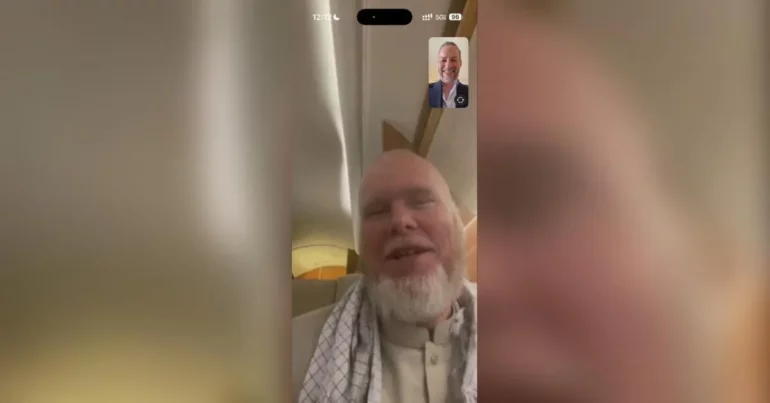

KABUL, AFGHANISTAN – Adam Boehler, the U.S. Special Envoy for Hostage Affairs, referring to the release of Dennis Coyle by the Taliban, said that “hostage diplomacy is dead.”
The U.S. Special Envoy for Hostage Affairs, in a post on X along with a photo showing him speaking with Dennis Coyle, wrote: “No trades. No money. Hostage diplomacy is dead.”
He emphasized: “We will not stop until everyone is home.”
The Taliban on Tuesday released Dennis Coyle, a 64-year-old U.S. researcher from Colorado who had been held in Afghanistan for more than 14 months without formal charges, the group’s Ministry of Foreign Affairs announced.
The Taliban’s Ministry of Foreign Affairs announced yesterday, following the visit of Zalmay Khalilzad, the former U.S. Special Representative for Afghanistan, that Dennis Coyle had been released from prison.
The ministry added that the Taliban’s Supreme Court released him after receiving a letter from members of Dennis Coyle’s family addressed to Hibatullah Akhundzada, the leader of the group.
Taliban Foreign Minister Amir Khan Muttaqi described the decision as a humanitarian act and emphasized that the group does not detain foreign nationals for political purposes. He said such cases are handled through judicial processes related to alleged violations of Afghanistan’s laws, without specifying which laws Coyle was accused of violating.
His release came after the U.S. Department of State placed Taliban-controlled Afghanistan on the list of “state sponsors of wrongful detentions.”
Coyle, a longtime resident of Afghanistan, had lived and worked in the country for over 20 years, focusing on research into local languages. He was detained from his apartment in Kabul in January 2025 and reportedly held in near-solitary conditions without formal charges.
Marco Rubio, the U.S. Secretary of State, had said that the Taliban use terrorist tactics and detain individuals for ransom and political leverage.
A number of other U.S. officials had also warned that if the Taliban did not release American citizens, Afghanistan would become “the next Venezuela and Iran.”
The Taliban have previously released U.S. detainees following negotiations with Washington. In January 2025, the group freed Americans Ryan Corbett and William McKenty in exchange for Taliban member Khan Mohammad, who had been serving a life sentence in the United States on narco-terrorism charges. In 2022, financier Bashir Noorzai was released from U.S. custody in return for American engineer Mark Frerichs.
The United States does not recognize the Taliban as Afghanistan’s legitimate government and conducts contacts indirectly, often through intermediaries such as Qatar and the UAE. Western governments, including the US, Britain, Canada, Australia, and Germany, continue to advise their citizens against all travel to Afghanistan, citing risks including militancy, kidnapping, and arbitrary detention.

